


A crowded aisle is not proof of exhibition success. A booth can attract hundreds of visitors and still produce very few opportunities if the team has no clear reason to start a conversation, no qualification process, and no follow-up plan. This trade show lead generation example shows how a focused campaign can turn a three-day event into a measurable sales pipeline.
Picture a B2B manufacturer exhibiting at a major industry show. Its products solve a costly production problem, but the category is technical and the buying cycle can run for months. The company does not need a stack of business cards. It needs meetings with plant managers, procurement leaders, and engineering decision-makers who have an active need and a realistic timeline.
The approach below is practical because it connects the stand design, visitor journey, staffing, and sales follow-up. Each part does a distinct job.
Trade Show Lead Generation Example: From Traffic to Meetings
For this example, the exhibitor has a 90 sqm custom stand at a large manufacturing exhibition. The campaign objective is to secure 40 qualified post-show meetings and identify at least 12 opportunities with potential to enter the sales forecast.
The company begins six weeks before the show by defining its ideal visitor. Rather than inviting every contact in its database, it identifies accounts in three verticals where downtime, waste, or slow throughput creates a measurable commercial problem. Existing prospects, dormant accounts, distributor introductions, and a small group of target companies are prioritized.
The invitation is specific: attendees are offered a 15-minute production-efficiency assessment at the stand. It is not framed as a product demonstration. That distinction matters. Senior buyers are more likely to make time for a useful diagnosis than a generic sales pitch.
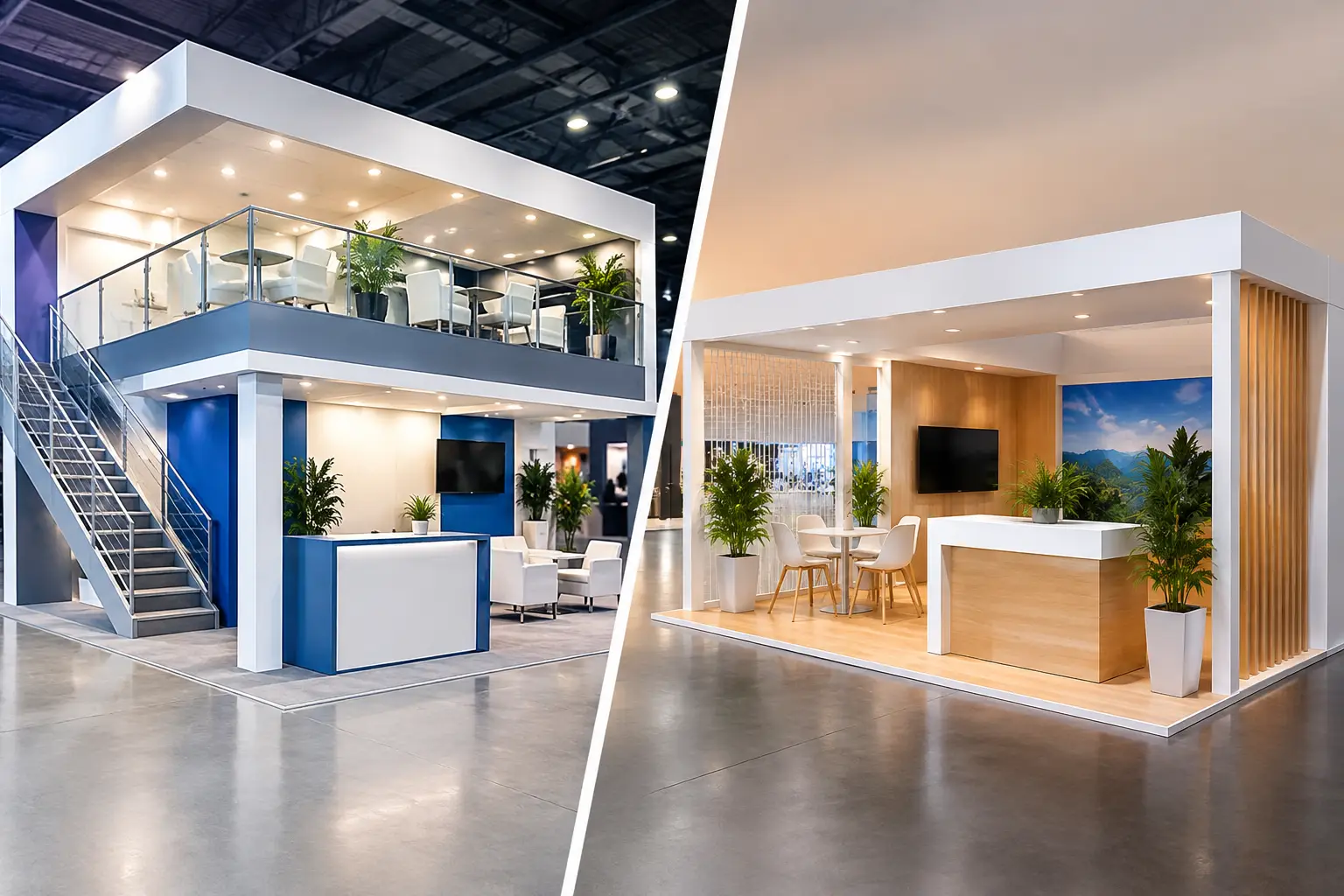
At the same time, the stand is designed around one strong message: “Reduce production bottlenecks before they cost the next shift.” A live equipment demonstration sits in the most visible area, while a semi-private consultation zone gives the sales team a place to discuss operating challenges without shouting over the aisle traffic. The message is repeated on the overhead branding, LED content, and demonstration graphics.
This is where exhibition design becomes commercially useful. The visual environment earns attention, but it must also make the next action obvious. Visitors should understand within seconds what problem is being solved and where to go if they want a relevant conversation.
The pre-show target list
The exhibitor sets a realistic target of 120 named contacts and 80 high-value walk-in prospects. Sales representatives are assigned to priority accounts before the event, so no one assumes another team member has made contact.
Each invited contact receives a short, personalized outreach sequence. The message references a likely business issue, explains the stand experience, and offers appointment slots. A reply does not need to be lengthy. Even a simple confirmation of interest helps the team prepare a more relevant conversation.
The key trade-off is scale versus relevance. A mass giveaway campaign may fill the booth, but it can overwhelm staff and dilute conversations with decision-makers. For brands launching a consumer-facing product, broad traffic may be the right goal. For a complex B2B sale, focused appointments and well-qualified walk-ins are usually more valuable.
Build a Booth Experience That Qualifies Visitors
At the show, the team uses a simple three-stage visitor journey. The first stage is attraction: a live demonstration, motion-led LED wall, and clear benefit statement draw attention from the aisle. The second is discovery: a trained host or booth representative asks a short opening question, such as, “Where do bottlenecks affect your output most often?” The third is qualification: a product specialist takes the visitor to the consultation area if there is a credible fit.
The opening question is deliberately problem-led. Asking, “Would you like to know about our company?” creates an easy exit. Asking about a familiar operating challenge gives the visitor a reason to talk.
Every serious interaction is captured through a digital lead form on a tablet. The form is short enough to use during a busy show but detailed enough for the sales team to act on. It records the contact’s role, company, pain point, current solution, project timing, budget context where appropriate, and agreed next step.
Not every contact needs the same treatment. The team grades leads as A, B, or C. An A lead has a defined requirement, authority or direct access to the buyer, and a near-term timeline. A B lead has a relevant need but needs nurturing or additional stakeholders. A C lead may be a future prospect, supplier, student, or general visitor. This protects the sales team from treating every scanned badge as a sales-ready lead.
For international exhibitions, qualification also needs to reflect territory and serviceability. A promising lead in a market where the company has no distribution capability may be valuable, but it should not be forecast in the same way as an account the local team can pursue immediately.
Give Stand Staff Clear Commercial Roles
A premium stand will not compensate for an unprepared team. The manufacturer in this example assigns roles before the show opens: one person greets and directs visitors, two specialists run demonstrations, two salespeople manage consultations, and a marketing coordinator owns lead data quality and appointment scheduling.
This structure prevents a common problem: technical experts becoming trapped in long conversations with low-priority visitors while senior prospects wait unattended. It also prevents lead information from disappearing into individual notebooks or being remembered differently by different team members.
Briefing matters as much as staffing numbers. Before the event, the team rehearses the first 30 seconds of the conversation, the qualification questions, the product demonstration, and the handoff to sales. They also agree on what not to do: no hard selling before understanding the need, no vague promises about follow-up, and no collecting details without recording a next action.
A fair hostess or trained event staff member can be particularly valuable at high-traffic shows. Their role is not simply to welcome people. When properly briefed, they help manage flow, identify appointment arrivals, direct visitors to the right expert, and maintain a polished experience during peak periods.
Follow Up While the Conversation Is Still Fresh
The highest-value step occurs after the lead is captured. For an A lead, the assigned salesperson sends a tailored message within 24 hours. It references the exact issue discussed, includes the agreed action, and proposes the next meeting. If the prospect asked for a site assessment, technical specification, or commercial estimate, that request is already logged and assigned internally.
B leads receive a relevant follow-up within 48 to 72 hours, often with a useful case example, product comparison, or invitation to a deeper online demonstration. C leads enter a broader nurture program, provided they have consented to future communications.
The campaign is reviewed one week after the event, then again after 30, 60, and 90 days. The exhibitor tracks more than lead volume: appointments held, qualified opportunities created, proposal value, pipeline value, and eventual revenue. It also checks operational measures such as show-up rates for booked meetings, data completion rates, and average response time after the event.
In this scenario, the company records 168 leads over three days. Only 52 are classified as A or B, which may seem modest beside a competitor claiming 500 scans. Yet 44 follow-up meetings are booked, 15 opportunities enter the forecast, and the resulting pipeline gives the marketing team a credible basis for assessing return on investment.
That is the point of disciplined lead generation. A smaller number of well-documented conversations can outperform a much larger contact list that receives the same generic email two weeks later.
What This Means for Your Next Exhibition
Your format should match the sales objective. A large custom stand with live demonstrations may be right for a flagship launch or a high-value industrial solution. A smaller stand can still generate excellent leads when the message is focused, the meeting area is intentional, and the team knows exactly whom it wants to meet. Country pavilions and multi-brand spaces require even more careful visitor routing so individual exhibitors do not lose ownership of their prospects.
The build partner should be involved early enough to support the commercial plan, not just execute a floor plan. At LemonTree Exhibitions, this means considering how sightlines, graphics, hospitality areas, demonstration zones, LED content, storage, and staffing support the conversations that matter. Design ambition and reliable on-site delivery should work toward the same business outcome.
A great exhibition stand gives people a reason to stop. A great lead process gives your sales team a reason to be glad they did.