

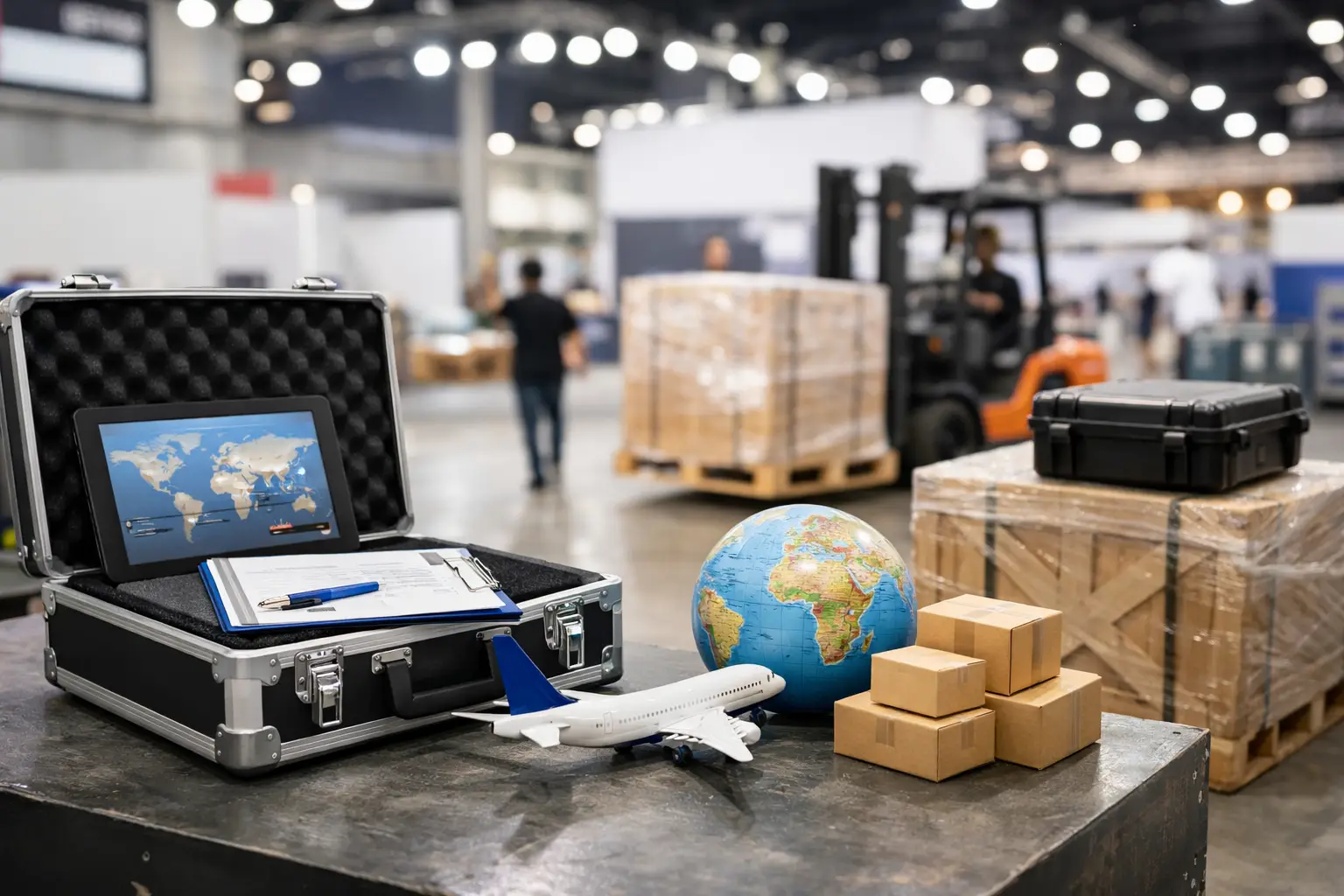

A stand can be approved, fabricated, and ready to impress – then lose its impact because a crate is held at customs or misses the venue’s receiving window. This international exhibition shipping guide is built for exhibitors who need more than a freight booking. They need their brand environment, product displays, graphics, and equipment to arrive intact, on time, and ready for installation.
International exhibition logistics is not a single task handed off at the end of a project. It affects stand design, material selection, production timing, insurance, documentation, and the labor schedule at the venue. The earlier it is planned, the more control you retain over cost and risk.
Build Your International Exhibition Shipping Guide Before Design Is Locked
Shipping decisions should begin while the stand is still being designed. A custom structure intended for Dubai, Riyadh, Las Vegas, Chicago, or Frankfurt may need to fit specific crate dimensions, venue loading rules, and local handling equipment. Large LED walls, delicate finishes, demonstration machines, and double-decker components all require different packing and handling plans.
Start with the event’s exhibitor manual. It defines the move-in dates, advance warehouse deadlines, direct-to-site delivery rules, permitted vehicle times, height restrictions, forklift requirements, and mandatory forms. Missing one of these details can create avoidable charges or leave materials waiting outside the official delivery window.
The shipping route should be selected against the true show deadline, not the opening day. Your freight must clear customs, reach the designated warehouse or venue, be unloaded, checked, and positioned before the installation crew starts work. Build contingency into every stage, particularly for first-time destinations, high-demand events, and shipments that include temporary imports.
A dependable stand partner coordinates the design, fabrication, packing, freight plan, and site installation as one schedule. That reduces the gaps that occur when a design team, a factory, a freight agent, and an onsite contractor each work from different assumptions.
Choose the Freight Method Around Risk, Not Just Price
Sea freight is often the most economical choice for large stands, heavy machinery, country pavilion elements, and repeat-use display systems. It also requires the longest planning horizon. Port congestion, transshipment delays, customs inspections, and inland trucking can affect the final arrival date, so sea shipments should leave well ahead of the show.
Air freight is faster and useful for urgent graphics, samples, compact display items, product launches, or replacement components. It is also considerably more expensive, especially when shipment volume is high. A practical strategy is often a hybrid shipment: send the main stand structure by sea or road, then ship time-sensitive graphics, product samples, and critical spares by air.
Road freight can be highly efficient for regional exhibitions, especially across connected markets. Yet border crossings still require correct paperwork and careful timing. Do not assume a short geographic distance means a simple delivery.
Your choice depends on four variables: the cargo’s volume and weight, the available lead time, the value of the contents, and the cost of failure. Saving on freight is rarely a win if it forces expensive last-minute air shipments, rushed venue labor, or a reduced stand build.
Pack for Reuse, Handling, and Fast Installation
Exhibition freight is handled repeatedly. It may move from workshop to truck, freight terminal, customs facility, advance warehouse, venue dock, and finally the show floor. Packaging must protect the contents through that full chain, not simply survive the first collection.
Custom-built wooden crates offer strong protection for structural components, premium finishes, lighting, and AV equipment. They also make inventory and reinstallation easier when every crate is clearly labeled with its contents, weight, dimensions, destination, and stand location. Reusable flight cases are particularly valuable for screens, graphics, tools, and smaller technical equipment.
Each crate should have a packing list that matches the master inventory. Avoid vague labels such as “stand materials.” Instead, identify individual items in language a customs officer and an onsite crew can understand: aluminum frame sections, printed fabric graphics, reception counter panels, LED modules, brochure racks, or product display shelves.
Mark fragile items clearly, but do not rely on warning labels alone. Use internal bracing, corner protection, moisture barriers where required, and separated compartments for small hardware. Keep a complete installation toolkit and a small set of critical spare parts in an accessible, clearly identified case. If a minor connector or fixing is unavailable onsite, a simple repair can become a serious delay.
Get Customs Documents Right the First Time
Customs paperwork is where many international exhibition shipments lose time. The core documents usually include a commercial invoice, packing list, transport document, and any destination-specific declarations. The invoice should accurately describe each item, state its country of origin, value, quantity, and intended use.
For goods that will return home after the exhibition, temporary import procedures may apply. An ATA Carnet can simplify temporary admission in participating countries, but it is not accepted everywhere and does not cover every type of item. Some markets require a temporary import bond, a local customs broker, or other guarantees that duties and taxes will be paid if goods are not re-exported.
Product samples, consumables, food items, pharmaceuticals, batteries, promotional giveaways, and wireless equipment can face additional restrictions. If products will be sold, consumed, distributed, or left behind, they may not qualify for temporary import treatment. Plan this early, because changing an item’s import status at the last minute can be costly.
Accuracy matters more than optimism. Declaring an unrealistically low value, using incomplete descriptions, or sending documents that do not match the physical cargo can trigger inspections and delays. Work with an experienced exhibition freight forwarder or customs specialist for the destination rather than relying on generic parcel-shipping assumptions.
Plan for the Venue, Not Just the Border
Clearing customs does not mean the shipment has reached your stand. Exhibition venues have strict delivery systems, and many use an official freight contractor for material handling. That contractor may receive freight at an advance warehouse, deliver it to the booth, store empty crates during the event, and return them after dismantling.
These services are often billed by weight or volume and can materially affect the project budget. There may also be charges for late warehouse delivery, overtime unloading, forklift use, waiting time, redelivery, or special handling. A heavy crate that was economical to fabricate can become expensive to move once it reaches the venue.
Confirm who is responsible for each handoff. Your logistics plan should clearly identify the collection point, export clearance, freight carrier, destination broker, warehouse, venue handling contractor, stand crew, and return shipment coordinator. Ambiguity at this stage creates the familiar but damaging question on move-in day: “Who has the crate release?”
Budget for the Costs That Do Not Appear in a Freight Quote
A freight quote is only one part of international exhibition shipping. Build a complete budget that includes pickup, export documentation, packaging, freight, customs clearance, insurance, duties or temporary import guarantees, local delivery, venue material handling, empty-crate storage, return shipping, and potential overtime.
Also set aside a contingency for delays and replacement items. The right amount depends on the size and complexity of the stand, but a contingency is particularly valuable for events with fixed opening times and high-value product displays. A small reserve can protect a much larger investment in floor space, marketing, travel, and sales activity.
Insurance deserves close attention. Standard carrier liability may be limited and may not reflect the replacement value of custom-built stand components, graphics, or display technology. Confirm what the policy covers during transit, storage, loading, unloading, and venue handling. Photograph the packed cargo before dispatch and record its condition again upon arrival.
A Practical Shipping Timeline for International Shows
For most custom stands, begin logistics planning when the exhibition space and core design direction are confirmed. Eight to twelve weeks before the event is often a sensible starting point for international freight, while major pavilions, oversized structures, or sea shipments may require more lead time.
Before dispatch, complete a final cross-check of the commercial invoice, packing list, crate labels, shipment dimensions, venue forms, and installation schedule. Share a single current version of the inventory with everyone who needs it. The stand crew should know exactly what is in each crate and which items must be opened first.
During move-in, assign one person to verify delivery, inspect for damage, and coordinate with the venue freight desk. After the show, the same discipline applies to dismantling. Photograph returned items, confirm that all crates are loaded, and make sure temporary-import goods leave the country within the required timeframe.
The best exhibition shipment is rarely the cheapest line item. It is the one that gives your team enough certainty to focus on visitors, meetings, and commercial results while the stand arrives exactly where it needs to be.