

A small booth has no room for mixed messages. When every wall, counter, and square foot needs to earn its place, the best exhibition ideas for small spaces are not about squeezing in more features. They are about making one strong brand promise impossible to miss.
For marketing teams and exhibitors, a compact footprint can be a commercial advantage. It forces sharper decisions, faster visitor understanding, and more purposeful conversations. The goal is not to make a 9-square-meter stand look like a 100-square-meter pavilion. The goal is to build a focused environment that draws the right people in and gives your team a practical place to engage them.
Start With One Message, Not a Product Catalog
The strongest small stands communicate their purpose from the aisle. A visitor should understand what you do, who you serve, or what makes your offer relevant within a few seconds. That requires restraint.
Choose one headline, one primary visual, and one central call to action. If you are launching a product, the product is the hero. If your service solves a costly business problem, lead with that outcome. A manufacturer exhibiting at an industrial show may focus on performance, precision, or lead-time reduction rather than attempting to display every category in its portfolio.
Branding should be visible above eye level and readable from the main approach route. This is especially critical at crowded shows such as GITEX, ADIPEC, Big 5, or Automechanika, where visitors scan dozens of stands as they move through the hall. Clear hierarchy will outperform dense graphics every time.
Build Upward When You Cannot Build Outward
Vertical design is one of the best exhibition ideas for small spaces because it creates presence without consuming valuable floor area. Tall back walls, overhead frames where venue rules permit, illuminated logos, and suspended visual elements help a smaller stand compete for attention.
A full-height graphic wall can give a compact booth the confidence of a much larger brand environment. It also offers a clean surface for oversized product imagery, campaign visuals, or an LED display. The trade-off is that height must support the stand’s message rather than become decoration. A tall structure with tiny text or several competing visuals still feels cluttered.
Lighting plays a major role here. Focused spotlights can define a product pedestal, while halo-lit logos and edge-lit graphics add depth to flat walls. Good lighting creates contrast and improves image quality for visitors photographing the stand, which can extend campaign visibility beyond the show floor.
Use an Open Layout That Invites a Quick Stop
In a limited footprint, physical barriers can cost you leads. Avoid putting a large reception desk directly across the front of the booth unless visitor check-in is essential. An open front gives attendees an easy reason to step in, browse, and start a conversation.
A practical small-space layout usually includes three zones: an attraction point facing the aisle, a short conversation area, and discreet storage. These do not need to be physically separated. A demonstration counter can function as the attraction point and meeting surface, while a concealed cabinet inside the counter holds brochures, bags, device chargers, and staff supplies.
Think carefully about traffic flow. If a visitor needs to walk around furniture to reach your team, the layout is working against you. If two people can stop to talk without blocking the aisle, you have created a more usable stand.
Choose Furniture With More Than One Job
Every item should justify its footprint. A branded counter can display a sample, hold a tablet for lead capture, and store materials. A small café-height table can support an informal product discussion, then serve as a surface for a demonstration. Slim stools may be useful for longer technical conversations, but too many seats can make a compact booth look like a waiting room.
Custom-built joinery is often more effective than renting generic furniture for this reason. It can be designed to fit exact dimensions, hide operational clutter, and carry brand finishes consistently across the stand.
Replace Printed Clutter With Purposeful Digital Content
Screens can make a small stand feel current and informative, but only when the content is planned for a live exhibition environment. A large video wall playing a long corporate film rarely holds attention. Short, silent-first loops with bold captions, product close-ups, before-and-after visuals, or simple data points work better from the aisle.
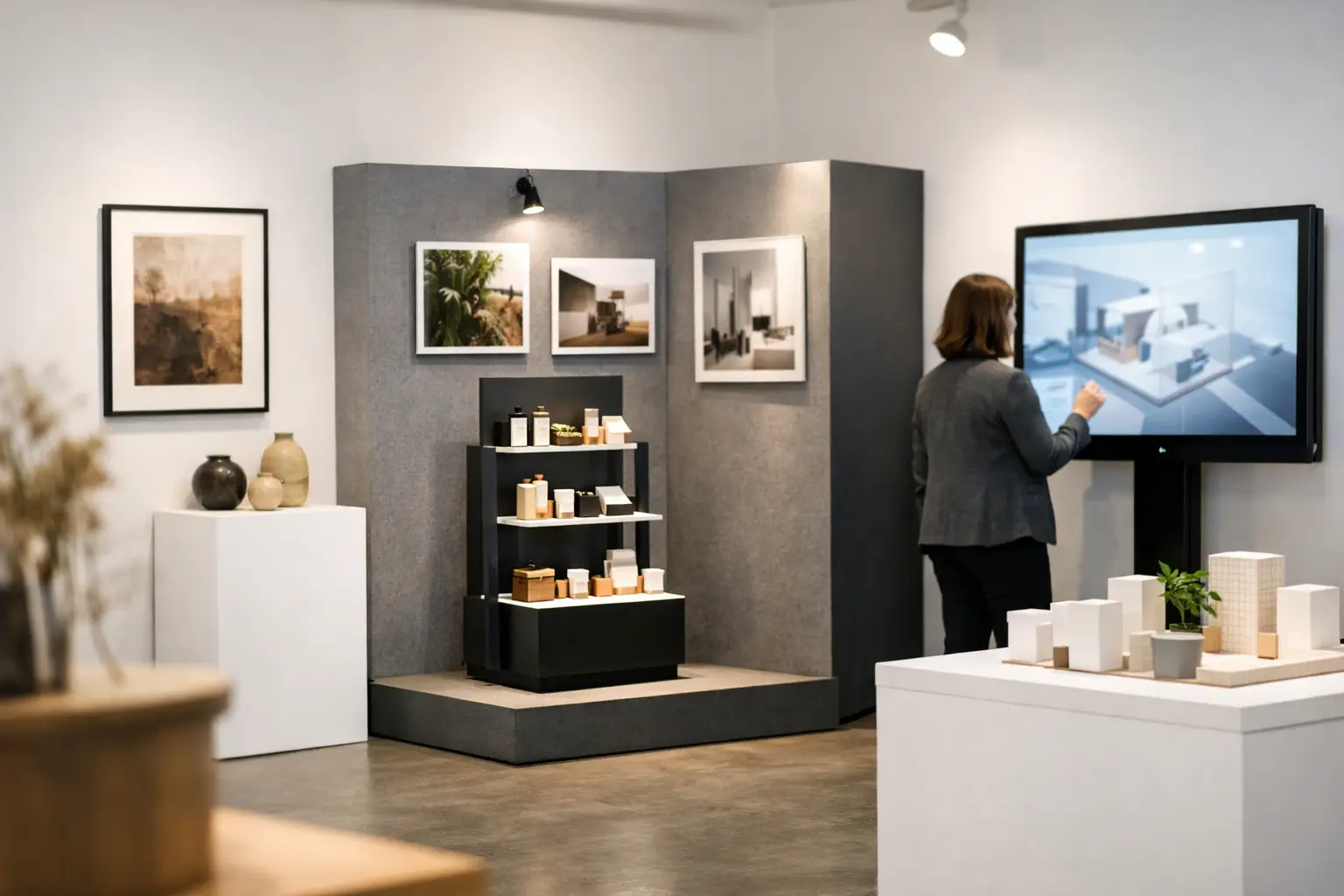
For technical products, a touchscreen can provide layers of information without covering the walls in text. A visitor can choose the relevant application, industry, or product specification, while your sales team uses the interaction to start a more targeted conversation. For brands with physical products, combine a digital screen with one or two real samples. Tangible proof still matters.
Do not assume more screens equal more impact. In a small booth, one well-positioned display is generally stronger than several competing devices. Screen glare, cable management, sound restrictions, and viewing distance should be considered during the design stage, not on installation day.
Make One Product Demonstration the Centerpiece
Live activity creates a natural reason for people to pause. A working product demonstration, material test, digital configurator, or brief expert presentation can add energy to a compact exhibit without requiring a large hospitality area.
The most effective demonstrations are easy to understand from a distance and repeatable throughout the day. A complex presentation that takes 20 minutes may suit pre-booked meetings, but it will not serve busy aisle traffic. Aim for a clear visual result in under two minutes, then give interested visitors a path to deeper discussion.
For example, a technology provider might show a dashboard solving one operational issue rather than presenting its entire platform. An FMCG brand may use a concise sampling or comparison experience. A building materials company can display a cross-section, finish, or installation result that visitors can touch. The format depends on the product, but the principle is constant: make the value visible.
Design Storage Before You Design the Graphics
Nothing reduces the premium feel of a small stand faster than boxes, personal bags, spare brochures, and cables appearing in view. Storage is not an afterthought. It is part of the visitor experience.
Even the smallest exhibit should include a lockable compartment for operations. Depending on the stand size, this could be built into a reception counter, a full-height wall, or a compact utility closet. Plan for daily consumables, staff belongings, cleaning supplies, giveaways, and technical equipment. If you expect a high volume of brochures, reconsider whether printed material is necessary at all.
This is also where experienced exhibition execution matters. A polished concept can fail if power access, AV ventilation, cleaning access, and storage needs are overlooked during fabrication and installation planning.
Create a Reason to Return or Share
Small stands do not need large-scale spectacle to be memorable. They need a distinct interaction that supports the campaign objective. A product personalization moment, a quick consultation with an expert, an industry benchmark tool, or a short scheduled demonstration can give visitors a reason to engage rather than simply collect a brochure.
The experience should fit your audience. Procurement teams may value a fast cost-of-ownership comparison. Engineers may respond to hands-on samples and technical proof. Export-focused businesses may benefit from a concise international market conversation. The best idea is the one that starts qualified conversations, not the one that generates the longest line.
Prioritize Quality Finishes at High-Touch Points
A modest footprint can still feel premium. Clean edges, consistent color matching, well-fitted graphics, quality flooring, and neat cable routing communicate confidence. Visitors may not describe these details individually, but they notice the difference between a stand that feels carefully built and one that feels temporary.
This does not mean every small booth requires an expensive custom structure. Modular elements can be highly effective for frequent exhibitors, particularly when they are planned around reusable components and refreshed campaign graphics. The decision depends on your show calendar, brand positioning, storage options, and the level of customization required at each event.
At LemonTree Exhibitions, small-footprint projects are approached with the same design discipline as larger custom stands: clarify the commercial goal, make the visitor journey work, and build every detail for reliable on-site performance. A compact space can make a very big statement when it gives the right visitor one clear reason to stop.