

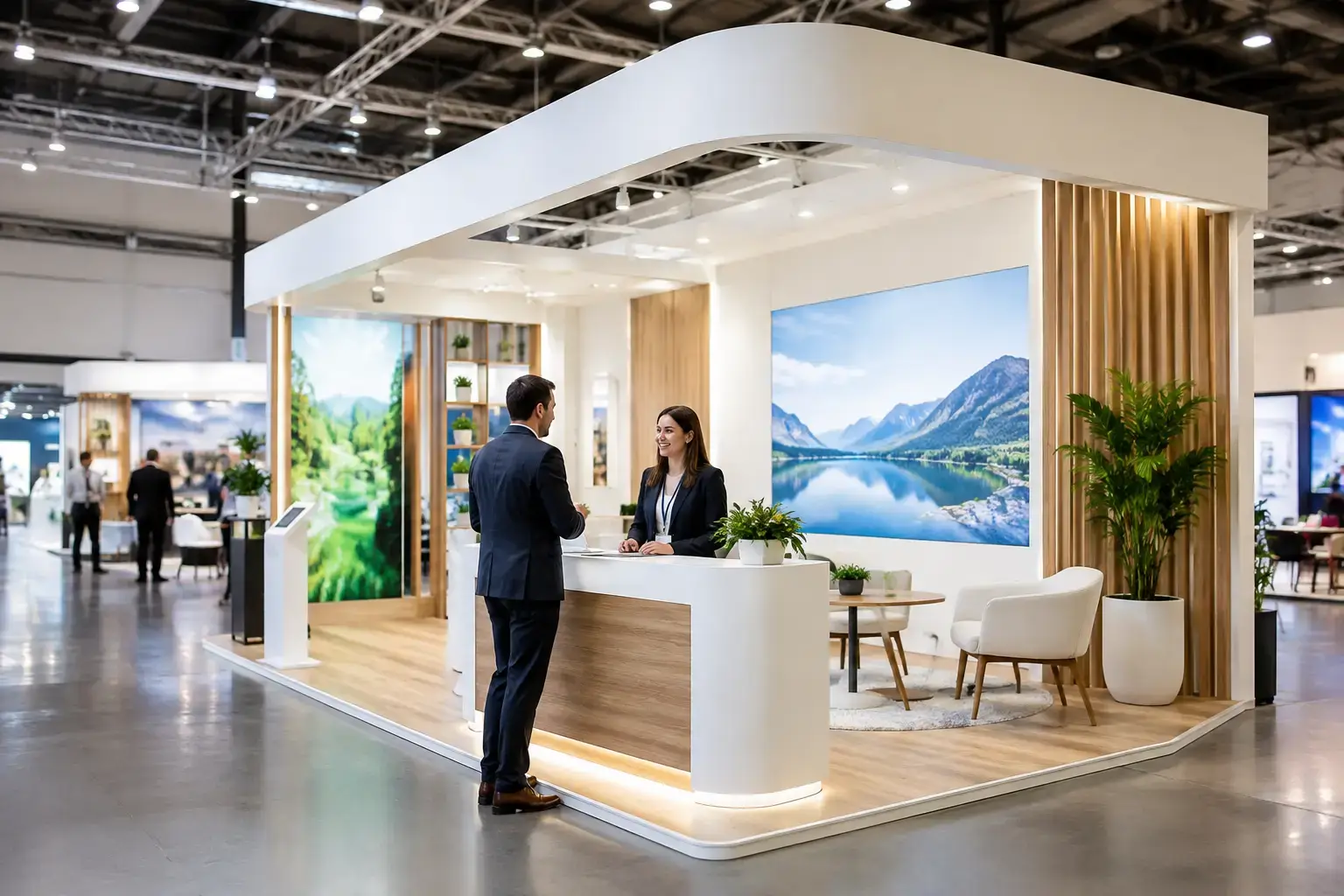

A 20-by-30-foot booth can cost as much as a major campaign touchpoint, yet visitors may decide whether to enter it in seconds. That is why exhibition design cannot begin with walls, finishes, or a logo placement. It begins with a commercial question: what must this space make possible for your business?
For a product launch, the answer may be demonstrations and qualified leads. For an exporter entering a new market, it may be instant credibility. For a government pavilion, it may be presenting many participating companies under one coherent national identity. The strongest stands turn those objectives into a physical environment that attracts the right audience, supports the sales team, and can be delivered without last-minute surprises.
Exhibition Design Starts With Visitor Behavior
Trade show visitors do not move through an exhibition hall like they browse a website. They scan, pause, make quick judgments, and follow visible activity. A stand has to communicate its value from the aisle before a representative has the chance to explain it.
This is where many projects lose momentum. A brief might request a “premium” or “innovative” stand, but those words do not tell a designer what a visitor should see first, where a product demonstration belongs, or how a sales conversation will begin. A better brief identifies the audience, the desired action, the priority message, and the practical needs of the team working the show.
A technology brand may need a large LED video wall to explain a platform quickly, paired with quieter consultation areas for serious buyers. An industrial manufacturer may get better results from a working product display, clear category signage, and storage that keeps samples and collateral out of sight. The visual language can be equally polished in both cases, but the space must serve different visitor journeys.
The aim is not to fill every available square foot. It is to create a clear path from attention to engagement.
The Three Decisions Visitors Make
Most visitors make three rapid decisions at a stand. First, they ask whether the brand is relevant to them. Next, they look for a reason to stop. Finally, they decide whether speaking to someone feels easy and worthwhile.
Good design supports each decision. High-level branding and a focused headline establish relevance. Product displays, motion content, live demonstrations, or a visible expert create a reason to stop. Open entry points, approachable counters, and well-positioned seating make conversation feel natural.
This is also why overly enclosed layouts can underperform. Private meeting rooms are valuable when deals require confidentiality, especially in pharma, energy, and enterprise technology. But if they dominate the frontage, they can make a stand appear closed or difficult to enter. The right balance depends on the sales cycle, attendee profile, and the proportion of scheduled versus walk-in meetings.
Build the Brand Story Into the Space
A memorable stand should feel recognizably like the brand without becoming a billboard with furniture. Color, form, lighting, materials, and graphics need to work together to express a single idea.
For example, a company positioned around engineering precision may use disciplined geometry, refined finishes, crisp information panels, and well-lit product details. A consumer-facing FMCG brand may require more energy, sampling zones, bold visual moments, and a layout built for throughput. Neither approach is inherently better. What matters is whether the environment makes the brand promise believable.
The best exhibition design also has hierarchy. Visitors should not need to read ten messages to understand what the company does. Lead with one central proposition, then use zones and graphics to reveal supporting proof: applications, product benefits, industry expertise, certifications, or customer outcomes.
Large-format graphics should be designed for viewing distance. A message that works on a laptop screen can disappear in a busy hall. From the aisle, the visual needs to be immediate. At close range, it should reward interest with useful detail. This layered approach helps the same stand speak to passersby, prospects, partners, and existing customers without visual clutter.
Choose the Right Format Before Approving the Concept
The stand format shapes both visitor experience and budget. Custom-built stands offer the greatest freedom in form, material selection, branding, and spatial planning. They are particularly effective when a company needs to make a strong market statement, launch a major offering, or accommodate demonstrations and hospitality.
Double-decker stands can create a commanding presence and add valuable meeting capacity where floor space is limited. They also introduce additional engineering, venue approvals, structural requirements, and build time. A second level is justified when the business case is clear, not simply because it looks impressive in a rendering.
Modular and reusable components can be a smart choice for brands exhibiting repeatedly across multiple cities. They can improve cost control and reduce material waste, though the system should still allow enough customization to avoid looking generic. Country pavilions demand another level of discipline, because individual exhibitors need visibility while the overall environment must remain consistent, navigable, and compliant with organizer rules.
A dependable design partner will explain these trade-offs early. The goal is not to sell the largest structure. It is to recommend the format that delivers the required impact within the realities of the venue, timeline, and budget.
Design for the Team Behind the Stand
A stand may look exceptional in photographs and still frustrate the people using it. Sales representatives need clear sightlines, accessible lead-capture points, product storage, power where it is needed, and places to have conversations at different levels of privacy.
Consider the rhythm of a busy day. Where will visitors queue for a demonstration? Can a host greet attendees without blocking the entrance? Is there a quick place for a five-minute introduction as well as a quieter setting for a 30-minute buyer meeting? Where will staff keep personal items, brochures, refreshments, or replacement product samples?
These details affect the quality of every interaction. They also affect staff confidence. When the environment is organized, representatives can focus on prospects rather than searching for cables, clearing tables, or directing visitors around congestion.
Staffing deserves attention as well. Fair hostesses, technical demonstrators, and sales personnel should be briefed around the same visitor journey the stand was designed to support. A bold build cannot compensate for an unclear greeting, slow handoff, or missed opportunity to qualify interest.
Execution Is Part of the Design
A concept is only as strong as its final build. Exhibition projects involve venue regulations, floor plans, rigging rules, electrical orders, fire and safety requirements, transport schedules, local labor coordination, installation windows, and dismantling deadlines. These are not separate from the creative process. They determine what can be built safely, on time, and to the expected finish.
This is why early coordination between design, fabrication, and project management matters. A designer who understands construction can propose details that retain their visual impact in the real world. An in-house fabrication team can monitor finish quality, test lighting and LED content, and solve problems before materials leave the workshop. A project manager can identify approvals and site constraints before they become expensive changes.
For international exhibitors, local execution capability is equally valuable. A brand showing in Dubai, Riyadh, Mumbai, Las Vegas, or Frankfurt needs consistent quality, but each venue and market has its own logistics. Experienced teams plan around those differences rather than treating them as an afterthought.
At LemonTree Exhibitions, this end-to-end control informs every project, from the first 3D concept to fabrication, installation, and dismantling. It helps clients protect both brand standards and event timelines across complex exhibition programs.
Make Sustainability a Practical Design Choice
Sustainable exhibition practices are most effective when they are planned from the start. Reusable structural elements, modular display components, recyclable materials, durable finishes, and responsibly planned graphics can reduce waste without making the stand feel compromised.
There are trade-offs. A fully bespoke feature may create a stronger one-time visual statement, while a reusable element can offer better value across several events. The right decision depends on how often the brand exhibits, whether stand sizes vary, and which components can be adapted without weakening the creative idea.
Sustainability also includes avoiding unnecessary freight and reducing rework. Accurate production drawings, realistic material choices, and early approval of graphics prevent the kind of last-minute changes that generate waste and strain budgets.
Measure What the Stand Actually Delivered
Footfall is useful, but it is not the whole story. A smaller number of qualified conversations can be far more valuable than a crowded stand with little buying intent. Before the show, agree on measures that reflect the real objective: booked demonstrations, sales meetings, lead quality, distributor inquiries, media engagement, or pipeline value.
Ask the sales team for feedback after the event. Did the layout help them start conversations? Which display drew the most attention? Were meeting areas sufficient? Did visitors understand the core message without explanation? Those answers improve the next build more than any generic trend forecast.
A trade show stand is a temporary environment, but its effect should continue long after dismantling. When exhibition design is planned around how people notice, understand, and act, it becomes a dependable business tool rather than a short-lived expense. Give the space a clear job to do, then build every detail around helping it do that job well.