

A 20-by-30-foot booth can look equally impressive whether you rent it or own it. The difference appears after the show closes: one option leaves you with storage, refurbishment, and freight decisions; the other gives you a fresh setup for the next market without carrying inventory. The right rental vs purchase exhibition booth decision is less about finding the lowest initial quote and more about matching your exhibition program, brand standards, and operational capacity.
For marketing teams, procurement leads, and exporters, the choice affects more than the stand budget. It influences how quickly you can adapt a campaign, how consistently your brand appears across regions, and how much internal effort goes into each event. A well-managed booth program should create attention on the floor while staying predictable behind the scenes.
Rental vs Purchase Exhibition Booth: The Core Difference
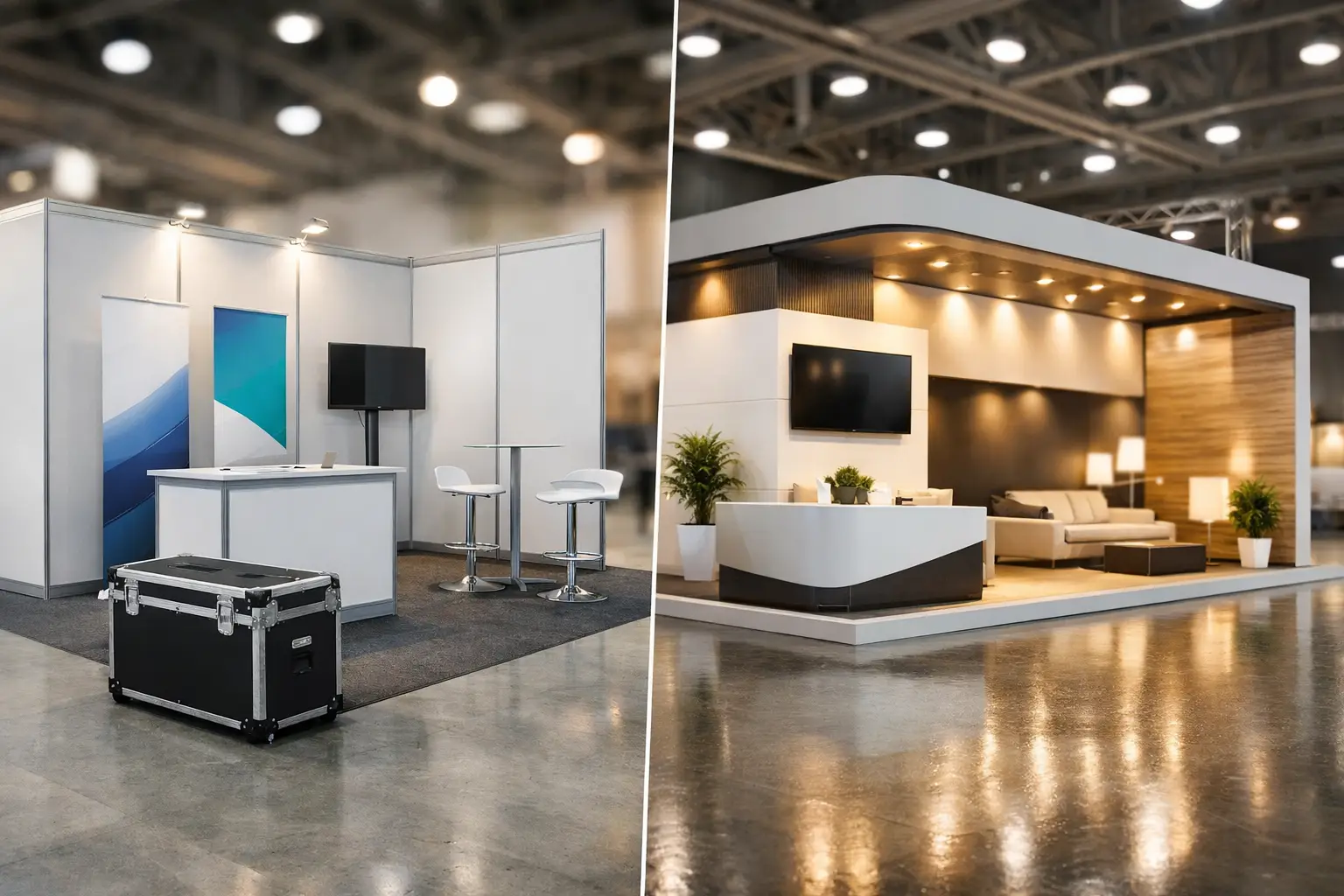
A rental booth is designed, fabricated or assembled for a specific event, then dismantled after the show. It can range from a modular system with branded graphics to a fully custom environment featuring LED walls, hospitality areas, product displays, storage, and meeting spaces. You pay for the design, build, installation, rental components, graphics, logistics, and dismantling required for that event.
A purchased booth becomes a company asset. Your business owns the structure, fixtures, furniture, and often selected display elements after the event. It can be stored and redeployed, with new graphics, revised layouts, or additional components added for future shows.
Neither route is automatically better. Renting favors flexibility and reduced asset management. Purchasing can reward a stable, high-frequency event calendar. The useful question is not, “Which costs less?” It is, “Which gives our team the strongest brand presence at the lowest total operating cost over the next two to three years?”
When Renting Makes Strong Business Sense
Rental is often the stronger choice for brands entering a new exhibition, testing a market, or exhibiting in several countries with different floor plans. A technology company showing at GITEX may need a high-energy demonstration zone and LED storytelling. At a smaller regional show a few months later, it may need a more compact booth focused on lead capture. Renting lets the format follow the objective rather than forcing every event into the same footprint.
It also reduces logistical responsibility. International exhibiting involves venue regulations, drayage, customs procedures, freight schedules, labor windows, and local installation requirements. Shipping an owned booth from the United States to the UAE, Saudi Arabia, or Germany can add cost and risk, especially if the design was not built for repeated transport. A local or regional rental build can eliminate unnecessary cross-border movement while preserving the look and quality your brand requires.
Rental is especially practical when:
- Your company participates in only one or two major shows each year.
- Booth sizes or event goals change frequently.
- You are launching a product, entering a new region, or testing an exhibition’s lead quality.
- Your team does not want to manage storage, inventory, maintenance, and freight.
- You need a premium custom look without tying capital to a physical asset.
A common misconception is that a rental booth must look generic. That only applies when a supplier relies on standard components without meaningful design development. A custom rental stand can be built around your campaign, visitor flow, product story, and sales conversations. The structure may be temporary, but the brand experience should not feel temporary.
When Purchasing Delivers Better Value
Buying is worth serious consideration when your company has a repeatable exhibition program. If you exhibit at several comparable shows each year, use a consistent booth size, and have a clear long-term brand platform, ownership can lower the cost per event over time.
For example, a manufacturing company attending four industry events annually may use the same core architecture: reception counter, demo bays, enclosed meeting room, overhead branding, and product shelving. Owning the durable structural elements while refreshing graphics and product messaging can create both savings and consistency.
The break-even point depends on more than the purchase price. It includes storage fees, insurance, repair work, warehouse handling, packing, freight, installation labor, and graphic replacements. A purchased booth that sits unused for 18 months is not an asset performing at full value. A rental solution used strategically at changing events may be financially smarter even if its per-show price is higher.
Ownership tends to work best when your booth program has three qualities: frequency, consistency, and operational discipline. You need enough events to spread the investment, similar enough footprints to reuse the system, and a dependable process for storing and redeploying it.
Compare Total Cost, Not the First Quote
The first quote can mislead both ways. A rental proposal may appear expensive because it includes everything required for a ready-to-open stand. A purchase proposal may appear cost-effective because the asset value is visible, while future expenses are less obvious.
Ask for a multi-event cost model. Compare the full cost of exhibiting over a defined period, such as six events across 24 months. Include design, fabrication, graphics, rental or ownership costs, packing, storage, shipping, installation, dismantling, venue services, repairs, and project management.
For a purchased booth, separate durable elements from event-specific elements. Structural walls, flooring systems, counters, lighting, and furniture may be reusable. Campaign graphics, product messaging, digital content, and certain finishes may need replacement each year. This distinction gives procurement teams a more accurate picture of expected reuse.
For a rental booth, ask what can be carried forward. Design concepts, graphic frameworks, digital content, furniture selections, and functional zones can often be adapted from one event to the next. Renting does not mean starting from zero every time. A capable exhibition partner can preserve the successful parts of a concept while changing the scale, layout, and message where needed.
Brand Consistency Does Not Require Owning Everything
Many established brands assume ownership is the only path to consistent presentation. In practice, consistency comes from clear design standards, approved materials, disciplined production, and detailed on-site execution.
Your brand should have recognizable elements that travel across formats: a defined color palette, architectural language, lighting approach, product display logic, hospitality style, and message hierarchy. These can be applied to a 100-square-foot booth in Chicago, a larger custom stand in Dubai, or a country pavilion environment without copying the same layout exactly.
This is where design and operations must work together. A beautiful concept that cannot be installed within venue timelines or adapted to local regulations creates pressure when it matters most. The strongest booth programs are designed for impact and built for reality.
Sustainability Changes the Calculation
Sustainability is another factor in the rental versus ownership discussion, but the answer is not as simple as “reuse is always greener.” Reusing a well-maintained owned booth can reduce material consumption. Yet shipping heavy structures repeatedly across long distances can increase the environmental cost of each appearance.
Rental can support a more responsible model when materials are sourced locally, modular components are reused across projects, and graphics are designed to minimize waste. The most practical approach is often hybrid: own the branded components that are repeatedly used and rent or locally fabricate the parts that depend on venue size, event requirements, or regional logistics.
Ask your stand partner how materials are repurposed after dismantling, what elements are designed for reuse, and whether the booth can be planned around local production. These answers reveal whether sustainability is being considered at the design stage rather than added as an afterthought.
A Hybrid Model Often Gives the Best Control
For many mid-to-large exhibitors, the best answer is neither fully rental nor fully purchased. A hybrid program gives you ownership of high-value, repeatable assets while preserving flexibility where it matters.
You may own a signature reception desk, product display units, branded furniture, digital screens, and reusable lighting features. For each show, you rent or build the supporting walls, storage areas, meeting rooms, flooring, and overhead structures according to the venue and footprint. This approach can keep the brand recognizable while avoiding the burden of transporting an entire booth worldwide.
It is also useful for companies with a flagship event and several supporting shows. Invest in a larger owned system for the event where major launches, senior leadership meetings, and media activity happen. Use premium rental stands for regional shows where the goal is distributor engagement, lead generation, or market visibility.
Questions to Settle Before You Decide
Before approving a booth strategy, align your marketing, sales, procurement, and event teams around a few practical answers. How many shows will you attend in the next 24 months? Will booth sizes remain similar? Do you need to change messaging or product displays often? Where will the booth travel? Who will manage storage and condition checks? What does success look like at each event: qualified leads, product demonstrations, distributor meetings, or brand visibility?
Those answers usually make the decision clearer. A company with a fixed annual calendar and a recognizable repeat format may benefit from ownership. A business with international growth plans, variable footprints, or evolving campaigns will often gain more from rental flexibility. For teams managing both conditions, a hybrid model provides the most balanced route.
LemonTree Exhibitions helps clients evaluate the decision as part of the wider exhibition plan, not as a standalone construction purchase. The objective is a booth that earns attention, supports sales conversations, and arrives ready when the doors open.
Choose the model that gives your brand room to perform at the next event, not just the one that looks most economical on a single spreadsheet.