

A visitor gives your booth only a few seconds before deciding whether to stop or keep walking. That is why the question of what makes an exhibition booth attractive is not simply about having the biggest structure or the brightest screen. It is about making your value obvious, credible, and easy to engage with amid a crowded show floor.
For marketing teams, the goal is not attraction for its own sake. An effective stand earns attention from the right people, gives sales teams a practical setting for conversations, and leaves visitors with a clear memory of the brand. The strongest booths combine creative ambition with disciplined planning – from the first sightline to the final lead capture.
What Makes an Exhibition Booth Attractive at First Glance?
An attractive booth answers three silent visitor questions almost immediately: Who are you? What do you offer? Why should I stop here?
That requires a clear visual hierarchy. Your brand name should be visible from the aisle and from relevant approach angles. The core message should be short enough to understand while walking. Product categories, campaign claims, and supporting graphics must reinforce that message rather than compete with it.
Many exhibitors try to communicate everything at once: company history, every product line, technical specifications, certifications, and multiple campaign slogans. The result can look busy even when the build quality is high. At a trade show, clarity is more persuasive than volume. Give visitors one strong reason to enter, then allow the stand team, displays, and demonstrations to reveal the detail.
Scale also matters, but it must suit the venue and the exhibiting objective. A 36-square-meter booth can make a stronger impact than a poorly planned 100-square-meter space if it has a distinctive silhouette, disciplined branding, and an open welcome. Larger stands offer more opportunities for meeting rooms, hospitality, and live product zones, but they also require careful traffic planning so the space does not feel empty or inaccessible.
Build a Visual Identity People Can Read From the Aisle
Color, form, and lighting create the first emotional response to a booth. They should feel unmistakably connected to the brand while being bold enough to stand apart from neighboring exhibitors.
A cohesive color palette is more effective than using every brand color at equal intensity. Use your primary colors to establish recognition, then introduce contrast to draw attention to the product, a demonstration area, or a key message. For premium sectors such as pharma, energy, or industrial manufacturing, visual confidence often comes from clean architecture, precise finishes, and controlled lighting rather than excessive decoration.
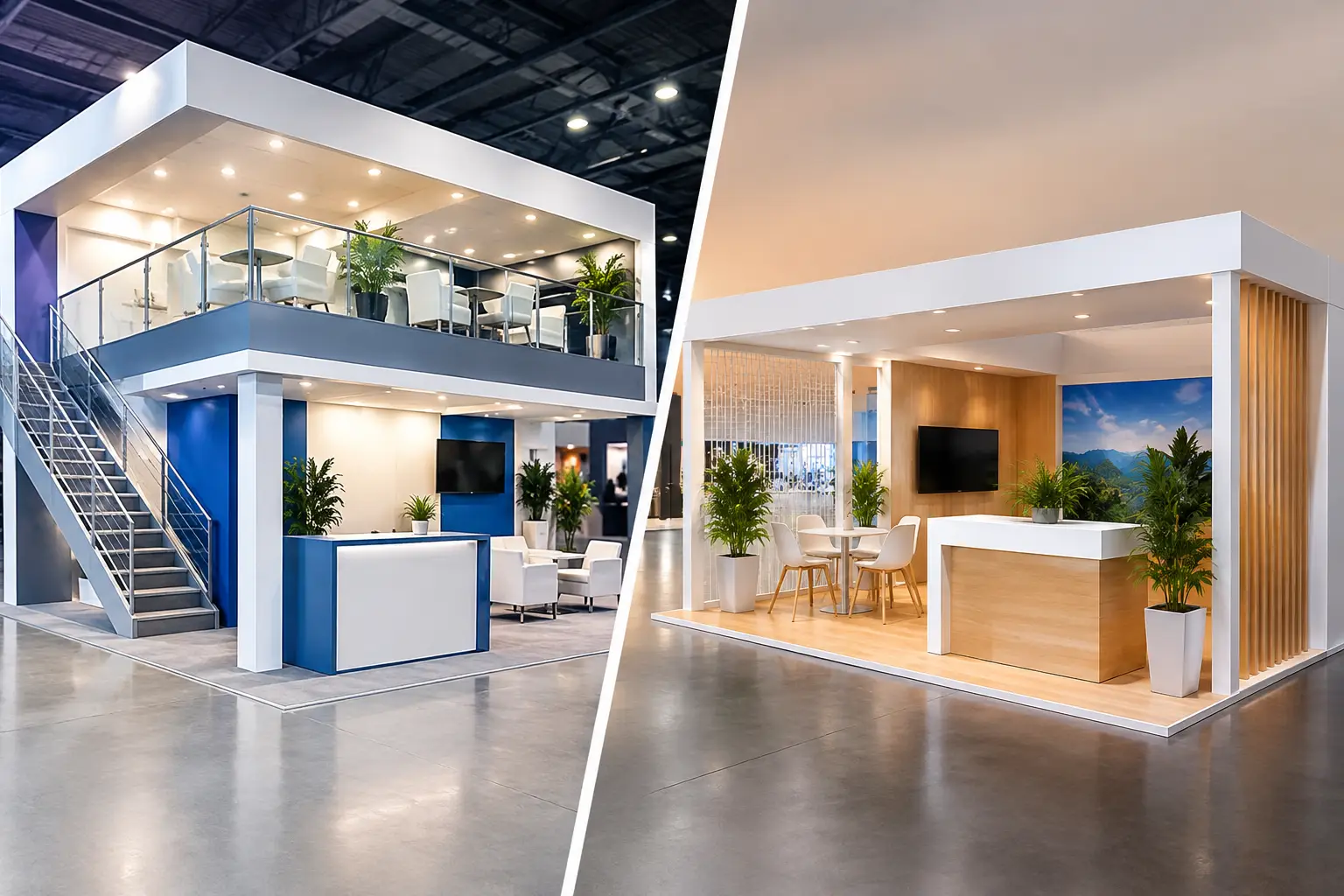
Structure matters just as much. A distinctive overhead feature, angled façade, sculptural product display, or thoughtfully designed double-decker stand can create a recognizable landmark on the floor. However, the feature must support visibility and visitor flow. A dramatic element that blocks sightlines, crowds the entrance, or makes visitors uncertain where to enter works against the objective.
Use lighting to guide attention, not just brighten the space
Good lighting adds depth and directs the eye. Ambient light creates a welcoming overall feel, while accent lighting gives products, graphics, and material finishes their moment. LED video walls can add energy and movement, particularly for technology, automotive, and real estate brands, but content needs to be purposeful.
A rapidly changing video wall with dense text can become visual noise. Short, high-contrast motion graphics and product visuals usually perform better from a distance. Save detailed technical information for touchscreens, brochures, or conversations once the visitor is inside the booth.
Make the Layout Easy to Enter and Easy to Navigate
A visually impressive stand loses value if people hesitate at the entrance. Visitors should be able to understand where to go without being directed. Open edges, clear pathways, and a visible focal point encourage natural movement from the aisle into the experience.
The best layout depends on your goal. A product-led brand may need demonstration stations along the perimeter, where passersby can see activity. A company pursuing senior-level meetings may prioritize a more private hospitality area and enclosed meeting rooms. A launch-focused exhibitor may place a hero product or live presentation area at the center.
In every case, avoid turning the front of the booth into a barrier. High counters, dense furniture, storage doors, and tightly packed displays can make a stand look closed even when the design is attractive. Keep the entrance zone active but breathable. Visitors need enough room to pause without feeling as though they have already committed to a sales conversation.
Back-of-house requirements deserve equal respect. Storage, pantry space, power access, staff belongings, and replenishment routes should be planned early. When operations are forced into public areas, even a premium build can quickly look untidy. Attractive exhibition environments are maintained as carefully as they are designed.
Give Visitors a Reason to Stay
Attention gets people to the booth. Relevance keeps them there.
The most effective engagement is tied directly to your offering. A machinery supplier might use a working sample or an augmented product walkthrough. A software company may offer a short, role-specific demo instead of a generic screen presentation. An FMCG brand could create a sampling moment that makes the product benefit tangible. For a complex B2B solution, a simple comparison display can be more valuable than an elaborate game.
Interactivity should never become a distraction from the commercial conversation. A crowd around a giveaway activity can look successful while producing few qualified leads. Before adding an experience, ask what it helps a visitor understand, feel, or do next.
Comfort also has a commercial role. A well-positioned seating area, accessible charging point, or quiet meeting zone signals that your business is prepared to invest time in a serious discussion. The trade-off is space: every lounge chair takes area away from display or demonstration space. The right balance depends on visitor volume and the expected length of conversations.
Put Products and Proof at the Center
Trade show visitors are naturally skeptical of broad claims. A booth becomes more attractive when it makes proof visible.
Show the actual product where possible. If the product is too large, technical, or restricted to transport, use accurate models, cutaways, live interfaces, high-quality video, or a guided virtual visualization. Make the benefit immediately legible. Rather than labeling a display with a product code, lead with the problem it solves or the result it delivers.
Credibility can also be built through concise proof points: measurable outcomes, recognizable project sectors, quality standards, or carefully selected client success stories. Keep claims specific and readable. A wall covered in logos may communicate scale, but one well-presented case study can do more to start a meaningful conversation.
This is particularly important when exhibiting internationally. A visitor who does not know your company should still be able to understand your market position without relying on a salesperson to explain the basics.
Staff Presence Is Part of the Booth Design
A beautiful booth can feel uninviting if the team inside it is disengaged. Staff behavior shapes the visitor experience as much as graphics and architecture do.
Brief the team on the central message, priority audience, product stories, and lead qualification process before the show opens. They should know where to stand, when to approach, and how to make the first question helpful rather than generic. Sitting behind a counter, looking at a phone, or forming a closed group with colleagues creates an immediate barrier.
For high-traffic events, event staffing and fair hostesses can support greeting, navigation, registration, and hospitality. They work best when their roles are clear and integrated with the sales team. Professional staffing should make the experience feel more organized, not more scripted.
Detail Is What Makes an Exhibition Booth Feel Premium
Visitors may not consciously notice every edge finish, cable route, or alignment, but they register the overall standard. Clean joins, consistent graphic application, polished surfaces, concealed wiring, and well-maintained furniture communicate care. In industries where reliability is central to the buying decision, those details support the brand promise.
Execution is where stand design becomes an operational discipline. Venue regulations, material approvals, electrical requirements, logistics schedules, and installation windows all affect the final result. A concept that looks exceptional in a 3D rendering must also be buildable, safe, transportable, and ready when the doors open.
That is why experienced exhibitors work with partners that control design, fabrication, installation, and dismantling as one coordinated process. LemonTree Exhibitions applies that approach across global show programs, helping brands protect both creative quality and on-site reliability. Sustainable choices can be built into the same process through reusable structural components, recyclable materials, and designs planned for repurposing after the event.
Attraction Should Lead to a Measurable Next Step
The most attractive booth is not necessarily the one that receives the most compliments. It is the one that creates the right commercial outcomes: qualified conversations, product demonstrations, meeting requests, pipeline opportunities, and stronger brand recall.
Set those measures before approving the design. If the target is lead volume, prioritize accessible engagement and fast qualification. If the target is relationship building, invest more in meeting comfort and hospitality. If the target is a product launch, create one compelling focal point that makes the launch impossible to miss.
A strong booth gives visitors a clear reason to stop, a useful reason to stay, and a confident reason to continue the conversation after the show closes.