
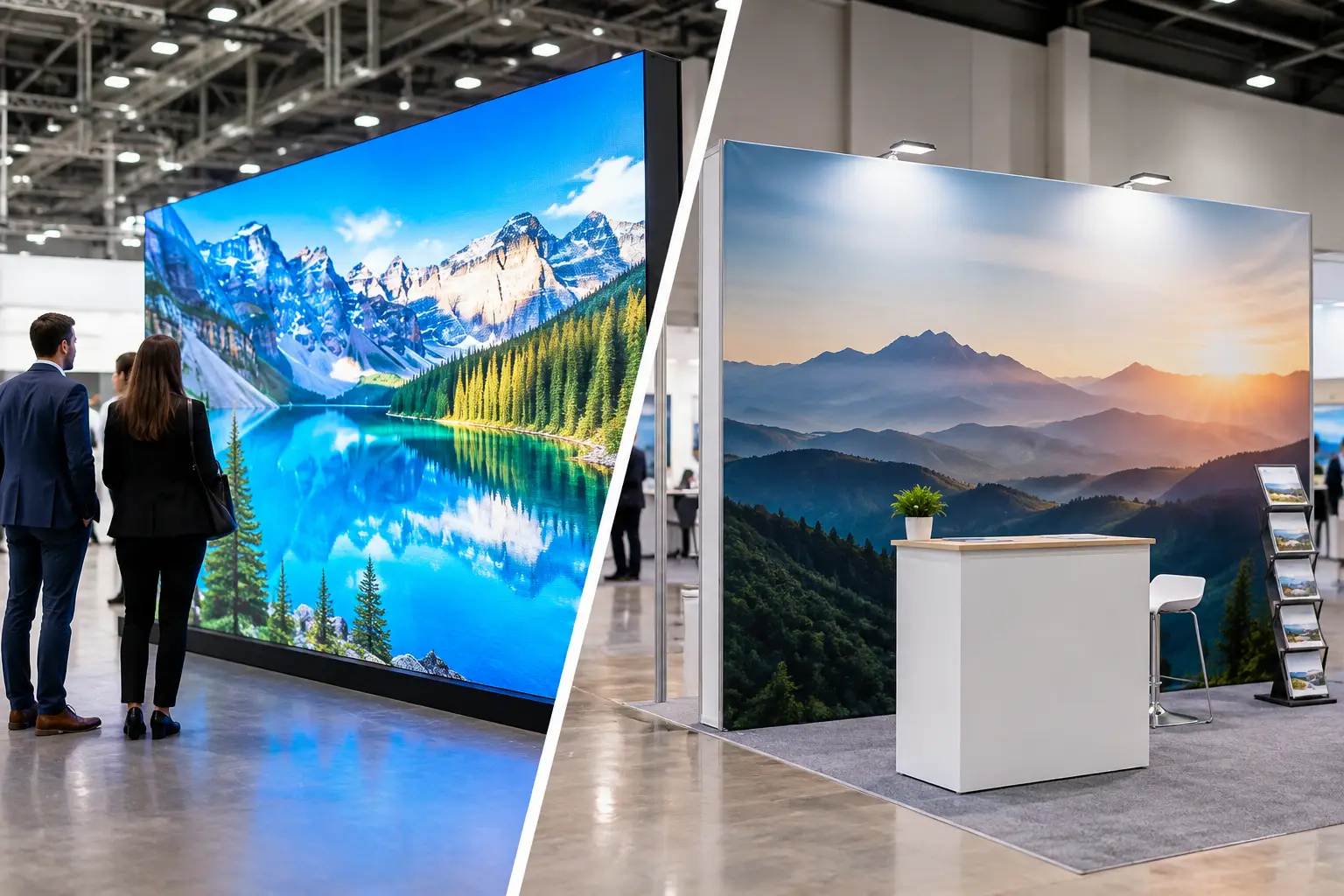

A busy trade show aisle gives visitors only a few seconds to decide where to look. That is why the choice between LED walls versus printed graphics is not simply a visual preference. It affects how your brand is noticed, how your message is understood, how your stand is built, and where your budget delivers the greatest return.
For some exhibitors, a high-resolution LED wall becomes the focal point that stops traffic and makes complex products easier to demonstrate. For others, expertly produced printed graphics create a premium, highly controlled environment at a far more practical cost. The strongest decision comes from matching the medium to the objective – not choosing technology for its own sake.
LED Walls Versus Printed Graphics: The Core Difference
Printed graphics communicate a fixed visual message. They can cover large surfaces, define zones, reinforce a campaign, and turn a custom exhibition stand into a recognizable brand environment. With the right materials, lighting, finishes, and installation, printed fabric, vinyl, backlit panels, and rigid graphic systems can look exceptionally polished.
LED walls communicate movement. They can show product films, motion graphics, live data, customer stories, demonstrations, and changing campaign messages throughout the show. Their advantage is not merely brightness. It is their ability to make one section of a stand work harder by delivering multiple messages over time.
That difference shapes the visitor experience. A printed wall rewards closer attention through clear composition, bold imagery, and concise messaging. An LED wall can create an immediate visual pull from across the hall, particularly when the content has a clear purpose and is designed for viewing at exhibition-floor distances.
Neither solution automatically creates impact. A poorly planned LED screen with generic video loops can feel distracting or wasteful. A printed stand with smart hierarchy, quality finishes, and strong lighting can look more premium than a screen-led space that lacks a coherent story.
When an LED Wall Is the Better Investment
LED walls are particularly effective when your product, process, or proposition benefits from being shown in motion. Technology companies can demonstrate platforms and interfaces. Manufacturers can show machinery operating in real-world conditions. Real estate brands can present walkthroughs, while energy and infrastructure businesses can explain large-scale projects that cannot physically fit on a stand.
They are also valuable when one stand must speak to several audiences. A company may need to show a corporate film in the morning, product-specific messaging during peak visitor hours, and a regional presentation during a distributor meeting. With an LED wall, the content can change without replacing physical graphics.
At major shows such as GITEX, ADIPEC, Big 5, and Middle East Energy, large-format digital displays can help established brands maintain visibility in halls filled with ambitious builds. This is especially true for island stands, double-decker stands, and spaces with long sightlines. A screen positioned high or facing key aisles can extend brand presence well beyond the stand perimeter.
However, screens require more than a rental line item. They need the correct pixel pitch for the viewing distance, a structure designed to carry the load safely, power planning, cable management, content formatting, and technical checks before the show opens. If video is central to the stand strategy, it also needs a content plan. A screen should not be left running a long corporate film that repeats every few minutes and asks passersby to wait for the relevant part.
Content determines the value of the screen
The most effective LED content is brief, legible, and intentional. Think of the screen as exhibition signage with motion, not as a television in a booth. Product benefits, visual proof points, animated diagrams, launch moments, and short customer-focused sequences generally perform better than dense presentations or fast-cut video that cannot be understood from the aisle.
For brands with frequent launches, multiple markets, or evolving product lines, this flexibility can justify the investment. The same physical stand structure can be refreshed with new digital messaging from one event to the next.
Where Printed Graphics Deliver More Value
Printed graphics remain one of the most dependable tools in exhibition design because they create scale, clarity, and brand consistency without adding technical complexity. They are often the smarter choice when the central message will remain stable throughout the event and when a stand needs strong visual coverage across several walls, meeting rooms, counters, or overhead features.
They are also ideal for exhibitors working within a defined budget who still need a premium result. Spending intelligently on well-designed graphics, dimensional branding, architectural finishes, focused lighting, and a polished visitor journey can generate a stronger outcome than allocating too much of the budget to one screen.
For pharma, industrial, FMCG, and B2B service brands, a carefully designed graphic program can make technical information easier to absorb. Large product imagery, concise benefit statements, certifications, market maps, and category visuals often work best when they are always visible rather than appearing briefly in a video sequence.
Printed graphics offer practical advantages as well. They are lighter to transport, simpler to install, less dependent on power and connectivity, and easier to deploy across multiple zones. For international exhibitions, these factors can matter significantly when freight windows, venue access, and local regulations are tight.
Print quality is a design decision, not an afterthought
The term “printed graphics” covers a wide range of outcomes. A basic vinyl panel and a tension-fabric backlit feature can serve very different brand positions. Material selection, color accuracy, resolution, lighting temperature, edge finishing, and alignment all influence the final result.
This is where execution discipline matters. Large graphics must be produced from properly prepared artwork, checked against stand dimensions, and installed without visible seams, wrinkles, bubbles, or misaligned logos. The graphic may be static, but there is nothing static about the planning required to make it look effortless.
Budget, Reuse, and Sustainability Considerations
The cost comparison between LED walls versus printed graphics should look beyond the initial quotation. LED walls involve screen rental or purchase, technical support, content production, power consumption, transport, rigging or structural integration, and contingency planning. Their cost can be justified when they create a visible commercial advantage or allow content to be reused across multiple events.
Printed graphics usually have a lower upfront cost, particularly for broad wall coverage. Yet they may need to be reprinted when campaigns, product ranges, language requirements, or brand guidelines change. Modular fabric systems and reusable stand structures can reduce this issue, allowing only selected graphic skins to be replaced for future shows.
Sustainability is also increasingly part of procurement discussions. Reusable stand components, repurposed materials, fabric graphics, and thoughtfully planned production can reduce waste. Digital displays avoid repeated print runs, but they also consume energy and require equipment transport. There is no single greener option in every case. The responsible choice is the one that considers reuse, event frequency, logistics, and the lifespan of the content.
A Combined Approach Often Performs Best
The choice does not always need to be either-or. Many high-performing exhibition stands use printed graphics to establish the brand environment and LED walls where motion adds real value. A large printed feature wall can provide a calm, premium backdrop, while a strategically placed screen demonstrates products or attracts visitors from the aisle.
This approach prevents the stand from becoming visually noisy. It also protects the budget by placing technology where it has a job to do: explaining, demonstrating, announcing, or drawing attention. The printed elements then carry the permanent brand story, wayfinding, meeting-room identity, and supporting messages.
For example, a machinery brand may use a central LED wall for operating footage and technical animations, while printed graphics communicate product categories, regional service coverage, and engineering credentials. A country pavilion may use LED displays for destination films and partner rotations, while printed architecture creates a consistent identity across many exhibitors.
Make the Decision Around Visitor Behavior
Before selecting materials, ask what you want visitors to do when they reach the stand. If the goal is instant awareness from a distance, moving content may help. If the goal is to establish credibility and communicate a concise proposition, print may be enough. If visitors need to understand a complex process, an LED demonstration can shorten the sales conversation. If the space needs to feel refined and consistent from every angle, printed surfaces may carry more of the work.
Also consider the show itself. Screen-heavy technology events reward motion differently from specialist industrial exhibitions, where buyers may value clear specifications, product access, and private meeting areas. Venue lighting, hall restrictions, stand location, viewing distance, and dwell time should all inform the design.
A dependable exhibition partner will assess these factors before recommending a solution. At LemonTree Exhibitions, that means designing the stand, graphics, digital integration, fabrication, logistics, installation, and dismantling as one coordinated plan rather than treating the screen or print as an isolated purchase.
The right choice is the one that gives your audience a clear reason to stop, understand, and start a conversation. Build from that moment, and every graphic surface or LED pixel earns its place.