

A 9-square-meter corner space at a busy trade show can either become a practical meeting point or disappear into a row of nearly identical walls. That is the real decision behind shell scheme versus custom booth planning. It is not simply a choice between a lower-cost format and a premium one. It is a decision about what the event must deliver for your brand, your sales team, and your pipeline.
For some exhibitors, a shell scheme is the right commercial call: fast, functional, and appropriate for testing a new show. For others, a custom booth creates the presence needed to launch a product, host serious buyer conversations, or stand confidently beside established competitors. The strongest choice begins with objectives, not with square footage alone.
What a Shell Scheme Gives You
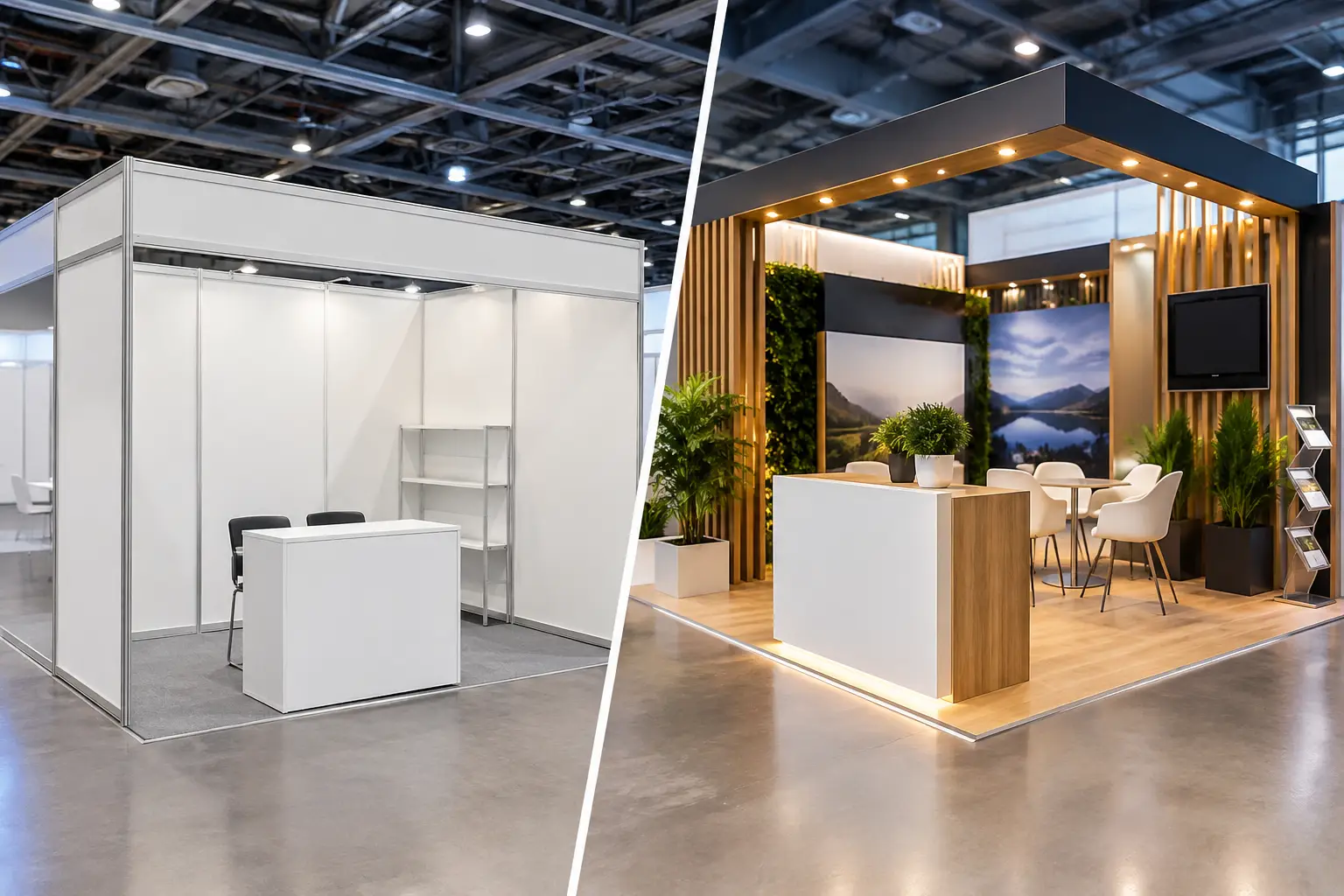
A shell scheme is a standardized modular booth provided by the event organizer or venue contractor. It typically includes aluminum framing, wall panels, carpet, basic lighting, a fascia board with your company name, and standard electrical access. You bring the graphics, furniture, product displays, and staff.
Its greatest advantage is predictability. The physical structure is known, the cost is easier to forecast, and the setup is typically handled within the organizer’s established schedule. For a small team attending an industry event for the first time, that reduced coordination can be valuable.
Shell schemes work particularly well when your goal is market research, lead qualification, distributor outreach, or maintaining a presence at a show where your audience already knows your brand. They can also suit companies exhibiting across many smaller regional events where consistent participation matters more than a large visual statement at each location.
The limitation is not that a shell scheme cannot look professional. It can. The limitation is the framework itself. Standard walls, fixed dimensions, height restrictions, and neighboring booths with similar proportions make differentiation harder. Strong graphics and smart merchandising help, but they cannot fully change the architecture of the space.
When a Custom Booth Earns Its Investment
A custom booth is designed around your brand, products, visitor flow, and commercial objectives. Its structure may include distinctive forms, integrated product displays, private meeting rooms, hospitality areas, LED video walls, elevated signage, storage, and tailored lighting. It can be built as a premium small-space solution or scaled into a large island stand, double-decker structure, or country pavilion.
The return comes from control. Instead of fitting your message into a supplied wall system, the environment is created to support how you want prospects to engage. A machinery manufacturer may need an open demonstration zone and a secure product platform. A technology company may need screen-led presentations with short, repeatable demos. A pharma brand may need a calm meeting area that supports detailed conversations and privacy.
Custom design is especially worthwhile when the event is a major revenue opportunity, a product launch, an international market entry, or a direct comparison point with high-spending competitors. At shows such as GITEX, ADIPEC, Big 5, Gulfood, and Automechanika, visual authority affects who approaches the stand and how long they stay.
A custom booth also gives sales teams better working conditions. Storage can be concealed, lead capture can be integrated into the visitor journey, and meeting spaces can be planned rather than improvised. Those operational details are easy to overlook during budgeting, yet they often determine whether a crowded stand feels productive or chaotic.
Shell Scheme Versus Custom Booth: Compare the Business Case
The best option depends on the role the show plays in your marketing plan. A shell scheme usually has a lower entry cost because the primary structure is already included. However, companies sometimes underestimate the add-ons required to make it presentable: printed panels, upgraded furniture, flooring, display fixtures, counters, lighting, power, AV equipment, and shipping. A well-dressed shell scheme can still require meaningful spend.
A custom booth requires a larger upfront investment, but it can produce more value per square foot when the design is aligned to a clear sales strategy. It creates more opportunities for visibility, product interaction, content capture, executive meetings, and qualified lead generation. For repeat exhibitors, reusable elements can also improve cost efficiency across a calendar of events.
Timelines differ as well. Shell schemes suit late decisions because much of the infrastructure is pre-arranged. Custom booths need earlier planning for design approvals, fabrication, venue submissions, logistics, and installation. That does not make custom execution slow. It means a dependable production partner needs enough time to protect quality and manage the details that sit behind a polished finished stand.
Brand perception is another deciding factor. If your competitors occupy large, carefully built spaces, a basic shell scheme can unintentionally signal a lower level of market commitment. Conversely, spending heavily on a custom build for a niche event with modest footfall may not be commercially justified. The goal is not to build the biggest stand. It is to build the right level of presence for the opportunity.
Start With Four Practical Questions
Before approving either format, ask what success will look like after the event. If the answer is a certain number of qualified conversations, calculate how the space will support discovery, demonstrations, and follow-up. If the answer is brand visibility, assess sightlines, hall positioning, competitor activity, and whether your messaging can be understood in a few seconds.
Next, consider the product. Compact consumer goods can be displayed effectively within a refined shell scheme. Large equipment, complex solutions, and products that require live interaction often benefit from a custom layout. The same applies to brands with multiple product lines that need a clear story rather than a collection of disconnected displays.
Then assess your audience. Senior buyers, government delegations, and channel partners may require a more private and hospitality-led setting. A high-volume audience may need an open, fast-moving layout with bold visual cues. Neither approach is inherently better, but each calls for different spatial planning.
Finally, be honest about your event frequency. If your company attends one strategic exhibition annually, a one-off custom investment may be justified by the stakes. If you exhibit frequently across markets, a modular custom system with adaptable graphics can offer a practical middle ground between a standard shell scheme and a fully unique build every time.
The Often-Missed Middle Ground
The choice is not always binary. A shell scheme can be elevated with full-wall fabric graphics, a branded entrance feature, coordinated furniture, product plinths, and purposeful lighting. This approach is ideal when you need stronger brand impact without changing the organizer-provided structure.
Likewise, a custom booth does not need to be extravagant. A compact custom stand can use clean architectural lines, premium finishes, smart storage, and disciplined graphic hierarchy to look more substantial than its footprint. In many cases, design restraint creates a stronger impression than filling every surface with messaging.
This middle ground is valuable for growing companies and exporters. It lets them present a credible, consistent identity in new markets while reserving larger investments for flagship events. The key is making sure every upgrade supports a specific visitor behavior, whether that is stopping, exploring, watching, or meeting.
Plan the Booth Around the Full Exhibition Operation
A strong booth decision also considers what happens before opening and after closing. Who will manage technical forms, venue rules, electrical orders, rigging requirements, delivery slots, installation, and dismantling? Who will ensure that graphics arrive correctly and that the stand is ready before the first visitor enters the hall?
These details matter at international shows, where venue procedures and local logistics can vary significantly. Working with an exhibition partner that controls design, fabrication, logistics, and on-site execution reduces handoffs and helps protect both the timeline and the finished quality. LemonTree Exhibitions manages this process in-house, from 3D concept design through installation and dismantling, giving clients one accountable team across complex exhibition programs.
Sustainability should also be part of the conversation. A custom booth can incorporate reusable structures, recyclable materials, and modular elements designed for future events. A shell scheme reduces structural waste through standardized reuse, but single-use printed panels and disposable decor can still add up. Ask how materials will be reused, repurposed, or responsibly handled after the show.
Make the Format Serve the Moment
Choose a shell scheme when speed, controlled spend, and a straightforward presence are the priority. Choose a custom booth when the event demands differentiation, richer engagement, and an environment built around your brand story. Choose a hybrid approach when you need to make a standard space work harder without overspending.
The most useful question is not, “Which format looks better?” It is, “What must this stand make possible?” When that answer is clear, the right investment becomes easier to see, and the exhibition space starts working as a serious business asset rather than a temporary address on the show floor.