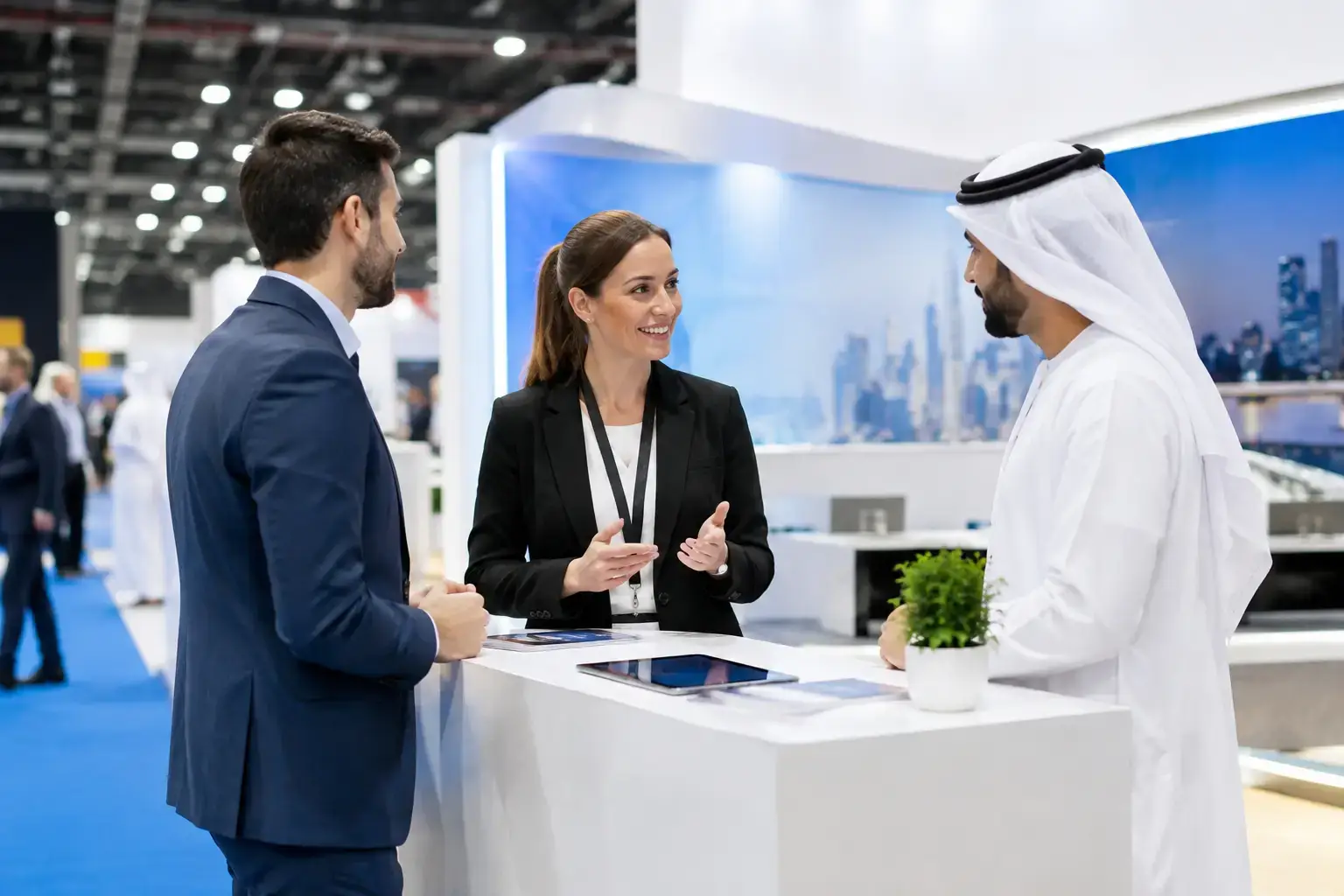



A crowded healthcare exhibition floor gives buyers only seconds to decide where to stop. At World Health Expo Dubai, a stand must do more than look polished. It needs to explain your value quickly, support credible business conversations, and give your team the space and tools to convert attention into qualified opportunities.
For medical device manufacturers, pharma brands, healthcare technology companies, distributors, and national trade bodies, the challenge is not simply showing up. It is creating an environment that makes a complex offer easy to understand while meeting the practical demands of a major international event.
Start With the Business Outcome, Not the Stand Size
The strongest exhibition stands begin with a clear commercial brief. Before discussing materials, LED screens, or meeting rooms, define what success looks like on the show floor. A company introducing a new diagnostic platform may need product demonstrations and clinical credibility. A mature manufacturer looking for regional distributors may need private meeting capacity and a highly visible brand presence. A government pavilion has a different task again: presenting multiple companies under one cohesive national identity.
Stand size matters, but it is only one decision. A 36-square-meter space can outperform a much larger booth if the message is clear, the visitor journey is intentional, and the team can engage prospects without congestion. Conversely, a large island stand can underdeliver if every square foot is used for visual impact and none is reserved for meaningful conversations.
Build the brief around three practical questions: Who must visit? What should they understand within ten seconds? What should happen after they leave? Those answers inform every design and operational decision that follows.
World Health Expo Dubai Requires Fast, Clear Communication
Healthcare buyers are rarely looking for vague brand statements. They want to know whether your solution is relevant to their facility, market, clinical workflow, procurement process, or distribution portfolio. Your stand should make that relevance immediately visible.
A concise message placed at the right height is more effective than walls of technical copy. Product categories should be easy to scan from the aisle. If your offer has a clinical, operational, and financial benefit, prioritize the one that is most likely to start a conversation, then give your sales team the tools to add detail.
For a medical equipment brand, that may mean placing the equipment in a live-use setting rather than treating it as a static display. For a digital health company, a focused screen demonstration can show the user journey better than a large looping corporate video. For pharma and laboratory exhibitors, the balance may lean toward a refined meeting-led space with clear product communication that respects applicable compliance requirements.
The right approach depends on what you are selling and who is attending. A product that needs hands-on evaluation deserves open demonstration space. A solution involving confidential commercial discussions needs acoustic consideration and seating that feels private without becoming uninviting.
Design the Visitor Journey Before Designing the Walls
A productive stand has a natural sequence: attract, orient, engage, discuss, and capture the next step. This does not need to feel scripted. It should simply remove friction for visitors and staff.
Start with open sightlines from the main aisles. Avoid creating a facade so enclosed that people cannot tell whether they are welcome to enter. Once inside, visitors should be able to identify the main product story, access a demonstration or conversation point, and move toward a meeting area without crossing through another interaction.
Meeting rooms are valuable, especially for high-value healthcare and distribution discussions, but they should not dominate the footprint. If too much of a stand is closed off, the public-facing area can feel quiet and inaccessible. A better balance often combines one enclosed meeting room with semi-private seating, allowing the stand to remain active while supporting serious conversations.
Use Technology Where It Improves the Sales Conversation
LED video walls, interactive displays, and product configurators can add impact at World Health Expo Dubai, but technology should earn its place. A large screen is useful when it shows a procedure, workflow, product range, or case-study result that cannot be demonstrated physically. It is less useful when it repeats generic brand footage with no connection to the visitor’s needs.
Consider what your team needs to explain repeatedly. If sales representatives spend the day describing a complex system setup, an animated visual can make the conversation faster and more consistent. If your product is too large, too regulated, or too delicate to bring to the venue, a high-quality digital demonstration may be the most practical alternative.
Technology also requires operational planning. Screen content should be tested in advance, playback should work reliably without depending on unstable connections, and controls should be easy for stand staff to manage. A powerful visual asset becomes a liability if it fails during peak visitor hours or distracts from a live discussion.
Plan for Comfort, Credibility, and Staffing
Exhibition design affects how people feel about a brand. In healthcare, where trust and precision matter, poor finishes, cluttered counters, uneven lighting, and visible storage can weaken credibility. The solution is not excessive luxury. It is disciplined execution.
Use materials and finishes that support your positioning while remaining practical for a busy show. Ensure product displays are well lit, cables are concealed, storage is sufficient, and branding remains visible when the stand is crowded. Comfortable seating, accessible counters, and clean refreshment points can also lengthen conversations and improve the experience for international visitors.
Your stand team is equally important. A striking space cannot compensate for unclear ownership or a lack of preparation. Assign roles before the event: greeters who qualify initial interest, product specialists who handle detailed questions, senior representatives for commercial meetings, and a lead responsible for stand operations. Brief the team on key messages, lead capture standards, meeting schedules, and escalation points.
If fair hostesses or event staff are part of the plan, give them a clear role beyond welcoming visitors. They should understand where to direct specific inquiries, how to manage appointments, and how to keep the visitor flow organized during busy periods.
Budget for the Full Experience, Not Just Construction
A stand budget is more reliable when it covers the whole exhibitor experience: design, fabrication, graphics, furniture, lighting, AV, logistics, installation, dismantling, permits, utilities, staffing, and contingency. Comparing only the headline construction cost can create problems later, particularly when changes are required close to the event.
Custom construction offers greater flexibility for brands that need distinctive product zones, large-format visuals, or private meeting rooms. Reusable modular elements can be a strong choice for companies attending several shows with similar requirements. The best option depends on your schedule, show calendar, brand ambition, and the degree of customization required.
A dependable exhibition partner should make these trade-offs transparent. At LemonTree Exhibitions, in-house design, fabrication, logistics, installation, and dismantling help clients maintain control from concept through handover, particularly when deadlines and venue rules leave little room for error.
Sustainability deserves attention as well. Reusing structural elements, choosing durable materials, reducing unnecessary print production, and designing components for future events can reduce waste without compromising impact. The key is planning reuse from the beginning rather than treating it as an afterthought.
Protect Time for Approvals and On-Site Execution
Major exhibitions reward early decisions. Late changes can affect fabrication schedules, graphics production, AV testing, logistics, and venue submissions. They can also increase costs at the point when options are most limited.
Lock the layout and core messaging early, then create a realistic approval path for marketing, sales, product, compliance, and procurement stakeholders. This is particularly useful for healthcare exhibitors, where product claims, visuals, and demonstrations may need internal review. Give each stakeholder a defined decision window so the project does not stall between design sign-off and production.
On site, execution should feel controlled rather than improvised. The stand needs to be installed, cleaned, tested, stocked, and handed over with time for a final walkthrough. Check the lighting from visitor eye level, test every screen and demonstration device, inspect graphics for alignment, and confirm that the meeting spaces work as intended.
The most effective presence at World Health Expo Dubai is not necessarily the largest or most elaborate. It is the one that makes the right visitor stop, understand, trust, and take the next conversation seriously. Plan for that moment with the same care you give to the product or service you are there to represent.