
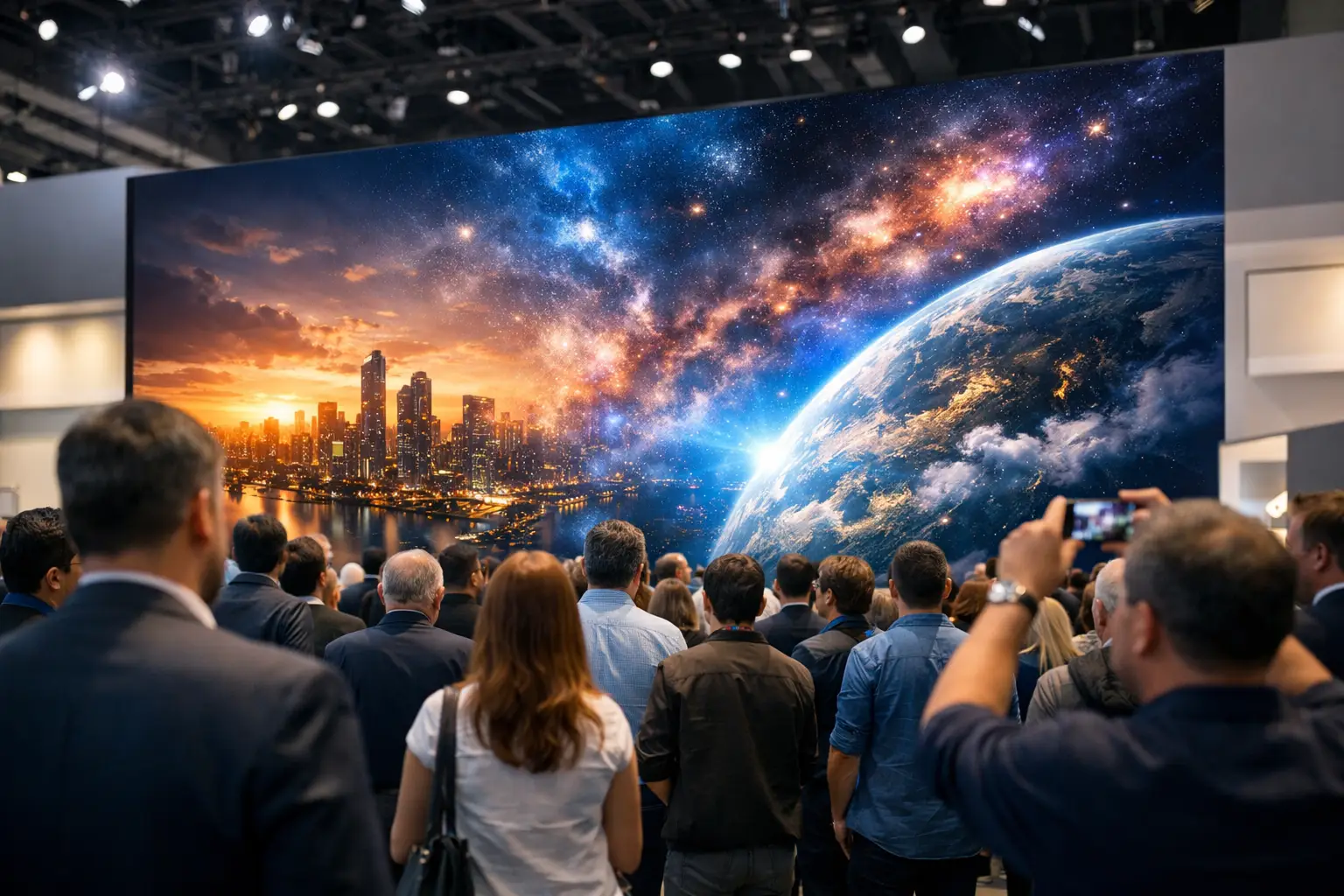

A busy trade show gives attendees only a few seconds to decide whether your booth deserves their time. An LED video wall for exhibitions can make that decision easier – but only when it is planned as part of the visitor experience, not treated as a large screen added at the last minute.
The strongest video walls do more than play attractive footage. They stop the right people in the aisle, clarify what your business offers, give sales teams a natural opening line, and make the stand easier to recognize from across the hall. Getting those results requires choices about location, screen specification, content, power, structure, and venue compliance long before installation day.
Start With the Job the Screen Must Do
Before selecting size or resolution, define the commercial purpose. A technology brand may need a wall that demonstrates a complex platform in 20 seconds. An industrial manufacturer may use it to show equipment operating in environments that cannot be recreated on the stand. A real estate developer may need immersive project visuals, while a consumer brand may prioritize energy, movement, and product launches.
One wall does not have to do every job. Trying to combine product films, corporate history, a long presentation, social content, and a live feed into one loop usually creates a message that is hard to follow. Decide what should happen at three distances: from the main aisle, near the edge of the stand, and during a sales conversation.
From a distance, visitors need a clear visual cue: your brand, product category, or a compelling proof point. At closer range, they should understand why they should stop. Once they are inside the booth, the content can support a deeper discussion through product detail, application stories, case studies, or live demonstrations.
Choose the Right LED Video Wall for Exhibitions
The best configuration depends on viewing distance, ambient light, stand geometry, and the type of content you intend to run. Bigger is not automatically better. A very large display with poor positioning can be less effective than a well-integrated screen that faces the natural visitor flow.
Pixel pitch should match viewing distance
Pixel pitch is the distance between LEDs on the display surface. A smaller pitch creates a sharper image at close range, while a larger pitch is often suitable for screens viewed from farther away. If guests will stand only a few feet from the screen during conversations or demonstrations, clarity matters more. If the wall is mounted high above a wide aisle, a larger pitch may be a sensible use of budget.
There is no value in paying for ultra-fine resolution that visitors will never notice. Equally, a low-resolution display can make polished brand content look soft or fragmented when placed near a reception counter or meeting area. Your stand designer and LED provider should assess the expected viewing zones, not simply quote a standard screen package.
Brightness and placement work together
Exhibition halls have uneven lighting conditions. Some venues use bright overhead lighting, while other locations include daylight from entrances or glass façades. LED displays are built for visibility, but brightness must be set appropriately. An overly bright wall can cause glare, overpower adjacent graphics, and become tiring for visitors and booth staff.
Placement is just as important. Avoid putting the main screen where a structural column, hanging sign, hospitality area, or product display blocks the view. On island stands, a central wall can provide strong visual presence, but it must not create a barrier that prevents people from entering. On smaller booths, a rear-wall display often works well because it draws the eye inward and gives the sales team a visual focal point.
Integrate the screen with the stand architecture
An LED wall should feel built into the brand environment. Framing, cladding, lighting, product shelves, counters, and meeting areas all influence how premium the final stand feels. Exposed cables, uneven edges, visible support structures, or poorly aligned panels can quickly undermine an otherwise strong concept.
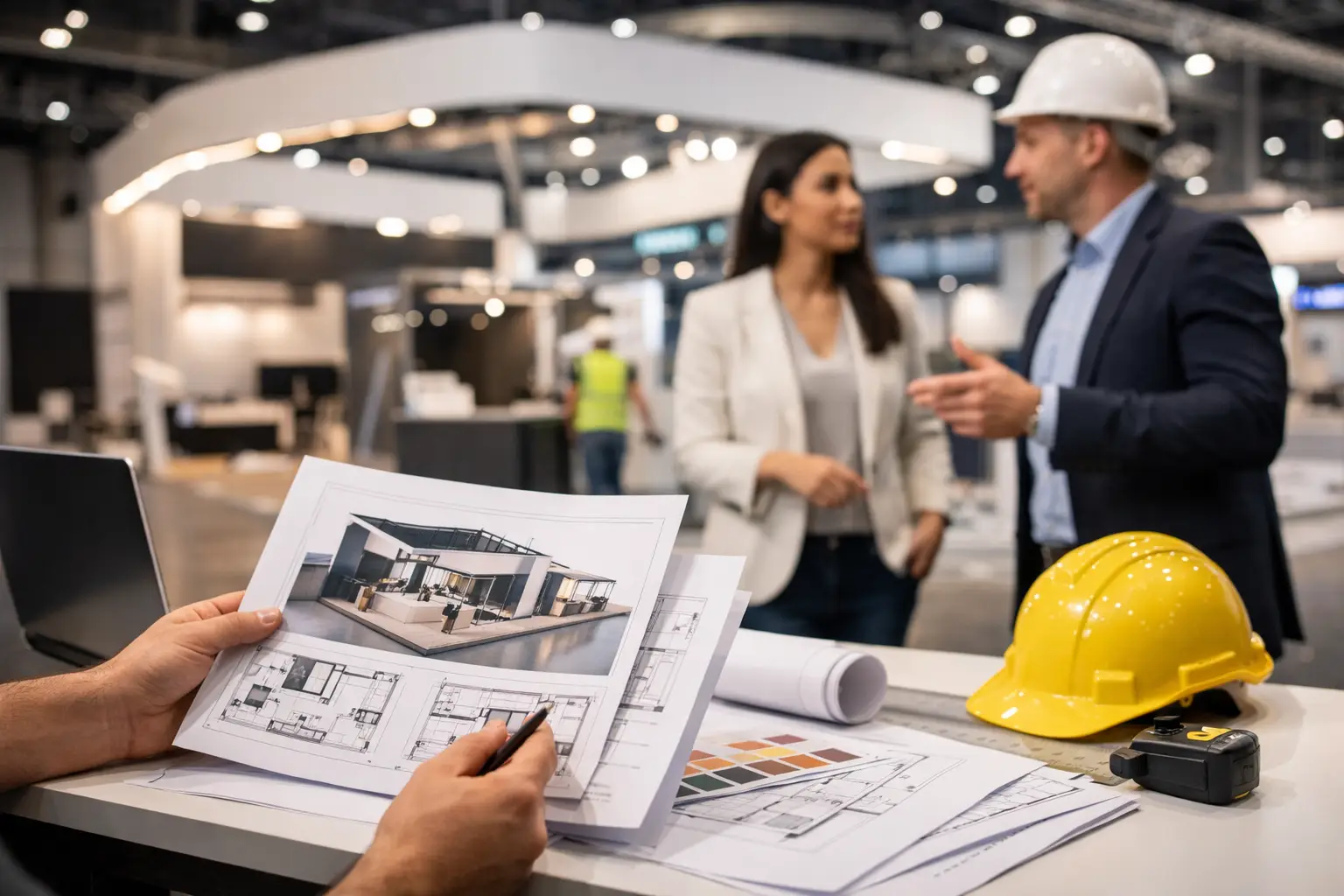
This is where end-to-end coordination matters. The screen affects wall loading, access panels, ventilation, electrical distribution, content testing, and installation sequencing. When the exhibition stand and AV elements are designed separately, small gaps in responsibility often become expensive problems on site.
Content Must Earn Attention Quickly
A screen cannot compensate for content that is slow, unclear, or designed for a boardroom. Trade show visitors are moving, talking, and processing dozens of competing messages. Your opening visual should communicate something meaningful without sound and without requiring a full minute of attention.
Use short motion sequences, bold product imagery, simple captions, and a clear rhythm. If your product needs explanation, show the outcome first, then reveal how it works. A manufacturer might begin with the finished component in use, followed by the process or engineering behind it. A software company might lead with a customer challenge and show the platform response in a few clean steps.
Avoid placing dense paragraphs, tiny charts, or lengthy subtitles on a large screen. These assets may look acceptable on a laptop but become unreadable in a busy aisle. Large type, high contrast, and restrained messaging generally perform better.
Sound should be considered carefully. Open exhibition halls are noisy, and many organizers restrict audio levels. If sound is essential to your presentation, use directed audio, headphones, or a semi-enclosed demonstration area. Otherwise, produce content that works fully on mute.
A practical content plan includes four elements:
- A high-impact loop for aisle visibility
- Product or application content for interested visitors
- A presentation or live demo format for scheduled moments
- A fallback playlist that can run reliably throughout show hours
The fallback matters. An empty screen, frozen frame, or looping error message is noticeable from a long distance and sends the wrong signal about operational readiness.
Plan for the Realities of the Exhibition Floor
LED video walls involve more than screen rental. Venue regulations may require power load details, structural drawings, fire-rated materials, rigging approvals, insurance documents, and scheduled access for installation. International exhibitions add logistics considerations such as freight timing, customs documentation, local labor rules, and equipment availability.
Build the technical plan early, particularly for major shows such as GITEX, ADIPEC, Big 5, or a large U.S. convention-center event. Late changes can affect booth layout, power requirements, labor calls, and content dimensions. A wall that looked straightforward in a 3D rendering may need redesign once the actual venue height, service locations, or sightline restrictions are confirmed.
Reliability should be designed into the project. Use professional-grade processing equipment, confirm backup media files, test all inputs before opening, and make sure a technician can access the rear or service side of the display if required. For a product launch or executive presentation, consider a backup playback source and a clear run-of-show with the event team.
At LemonTree Exhibitions, LED walls are planned alongside the stand structure, fabrication, logistics, and on-site installation. That single point of coordination helps protect both the design intent and the delivery schedule, particularly when projects involve complex builds or multiple vendors.
Spend Where Visitors Will Notice
The budget for an LED wall can vary widely based on screen size, pixel pitch, installation height, content production, control systems, and show duration. The right question is not simply, “What is the cheapest screen?” It is, “Which investment will improve visibility and visitor engagement for this specific booth?”
For a compact stand, a strategically placed medium-sized wall with excellent content can outperform a vast display running generic footage. For a large island stand, multiple smaller screens may guide visitors through different product zones more effectively than one dominating surface. Curved screens, transparent LED, and interactive formats can create memorable moments, but they should support the brand story rather than become a costly distraction.
Also consider reuse. Campaign footage, product animations, and modular screen concepts can often be adapted for future shows, customer events, and showroom environments. Planning for reuse makes content production more commercially efficient and helps create consistency across markets.
The most successful exhibition screen is not the one with the most pixels. It is the one visitors remember clearly enough to walk into your stand, start a conversation, and understand why your brand belongs on their shortlist.