

A small booth gets judged fast. At most trade shows, you have a few seconds to tell visitors who you are, what you do, and why they should stop. That is why the best exhibition stall ideas for small business are not about filling space with more graphics or furniture. They are about making smart design choices that help your brand look focused, credible, and easy to approach.
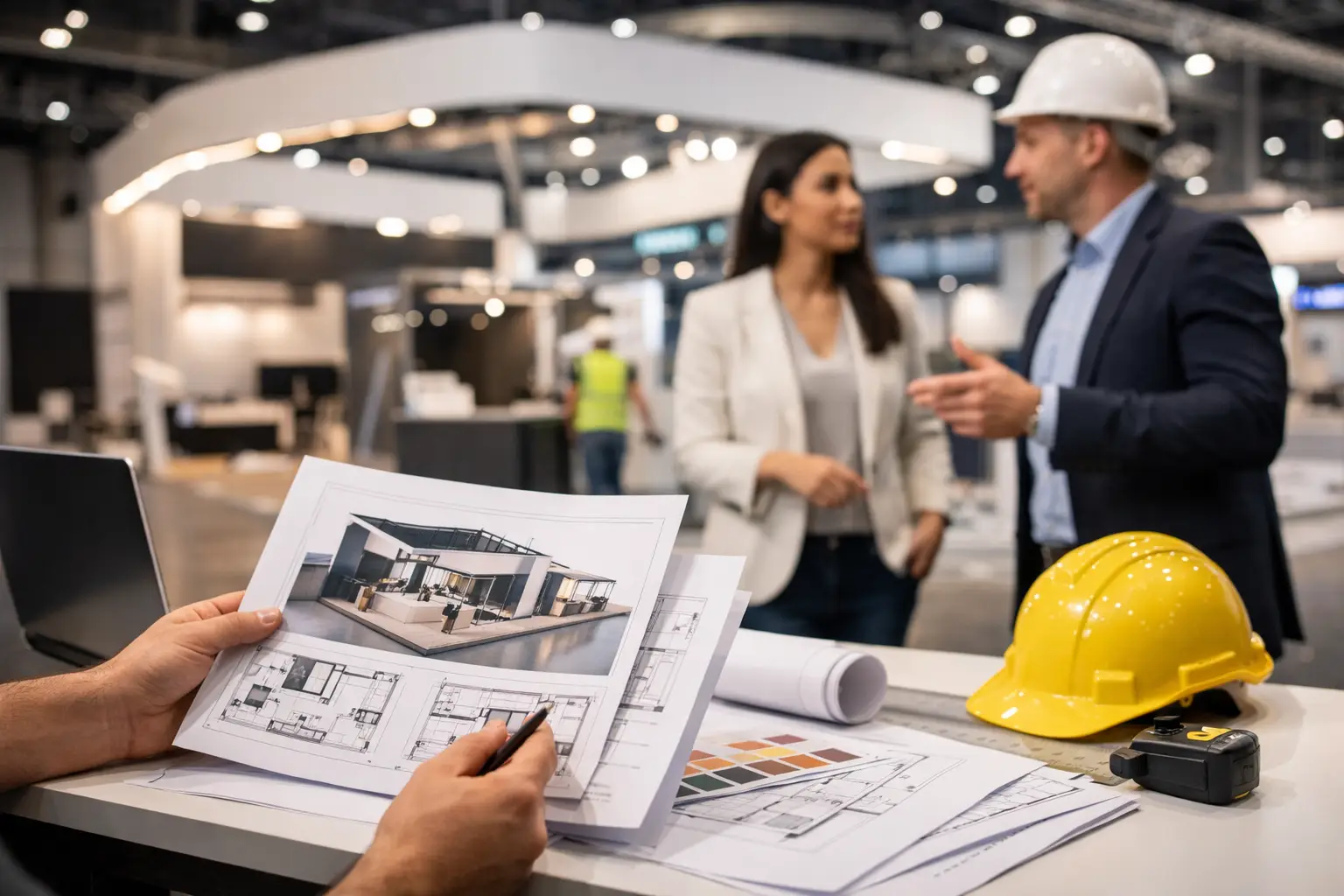
For smaller brands, startups, and growing exporters, the challenge is rarely creativity alone. It is balancing impact, budget, logistics, and lead generation. A booth can look impressive in a render and still fail on the show floor if the messaging is unclear, the layout blocks movement, or the setup is too complicated for the venue timeline. Good exhibition planning solves for all of that.
What makes small exhibition stalls work
A smaller footprint can be an advantage when the design is disciplined. Visitors are less likely to feel overwhelmed, and your team can control the conversation more easily. The trade-off is that every visible element has to earn its place. If one wall says too much, one counter is too large, or one screen is placed badly, the whole space starts feeling crowded.
The strongest small stalls usually do three things well. They communicate one core message at a glance, they create a natural stopping point, and they support a simple sales conversation. That could mean a product demo, a consultation table, a touch screen, or a sample display. The format depends on your sector, but the principle stays the same.
11 exhibition stall ideas for small business
1. Build around one clear message
Many small booths try to say everything at once. That is usually the first mistake. Instead of listing every product, service, and company milestone, choose one headline message that answers the visitor’s first question: what do you want to be known for at this event?
If you are launching a product, make the launch the center of the stall. If you are entering a new market, emphasize capability and trust. If the goal is distributor meetings, make the stand feel professional and conversation-friendly. Focus creates more impact than volume.
2. Use height to look bigger without renting more space
When floor space is limited, vertical design matters. A raised branding header, suspended element, or tall backlit wall can help a small stand look more established from a distance. This is especially useful in crowded halls where ground-level branding gets lost.
There is a practical limit, of course. Venue rules, rigging permissions, and budget all affect what is possible. But even a modest increase in height through structured branding panels can improve visibility significantly.
3. Choose open layouts over heavy enclosures
Small booths work better when they invite people in rather than fence them out. Closed cabins, oversized storage, and bulky counters can make the space feel smaller than it is. In most cases, a cleaner front edge and open corners improve visitor flow.
That does not mean every brand should avoid private areas. In sectors like pharma, industrial manufacturing, or government trade promotion, some level of enclosed meeting space may be necessary. The key is proportion. If privacy matters, keep the enclosed area compact and make the public-facing zone do the visual heavy lifting.
4. Make one product hero piece the center of attention
A small stall becomes easier to understand when it has a focal point. That could be a machine component, a product pedestal, a live sample area, or a digital demonstration wall. The point is not to show everything equally. It is to guide attention.
For technical businesses, this works particularly well when the hero piece is supported by short, benefit-led messaging. Visitors do not want to decode a wall full of features while walking an aisle. They want to know what the product does and whether it is relevant to them.
5. Use lighting as a design tool, not an afterthought
Lighting changes how premium a booth feels. Even with a modest footprint, a well-lit stand looks more intentional and more trustworthy. Backlit graphics, focused spotlights, and shelf lighting can create depth without adding physical clutter.
This is one of the most cost-effective upgrades for smaller exhibitors. The caveat is that lighting has to support the product and brand, not overpower it. A dramatic setup may suit a technology or beauty brand, while a B2B engineering exhibitor may benefit more from clean, bright, functional lighting.
6. Add digital screens only when they serve a purpose
A screen can bring movement and polish to a small stand, but too many exhibitors use one as decoration. If the content is generic, repetitive, or hard to follow without audio, it will not do much for engagement.
The better option is targeted use. Show a short product demo, a before-and-after installation, a manufacturing process, or a concise brand film that supports your sales conversation. For some exhibitors, an LED display makes sense. For others, a single well-positioned monitor is enough. Bigger is not always better if the content is weak.
Small booth design is really about behavior
The most effective exhibition stall ideas for small business are built around how people move, pause, and engage. Visitors do not experience your booth as a floor plan. They experience it as a sequence. First they notice the branding. Then they decide whether to slow down. Then they look for a reason to stay.
That is why functional decisions matter as much as visual ones. Where your team stands, where brochures are placed, how demos start, and whether seating feels inviting all influence performance on the show floor.
7. Replace brochure racks with conversation points
Printed literature still has a place, especially in sectors with technical buyers. But racks full of catalogs often become visual clutter. A better approach is to keep printed material available without making it the centerpiece.
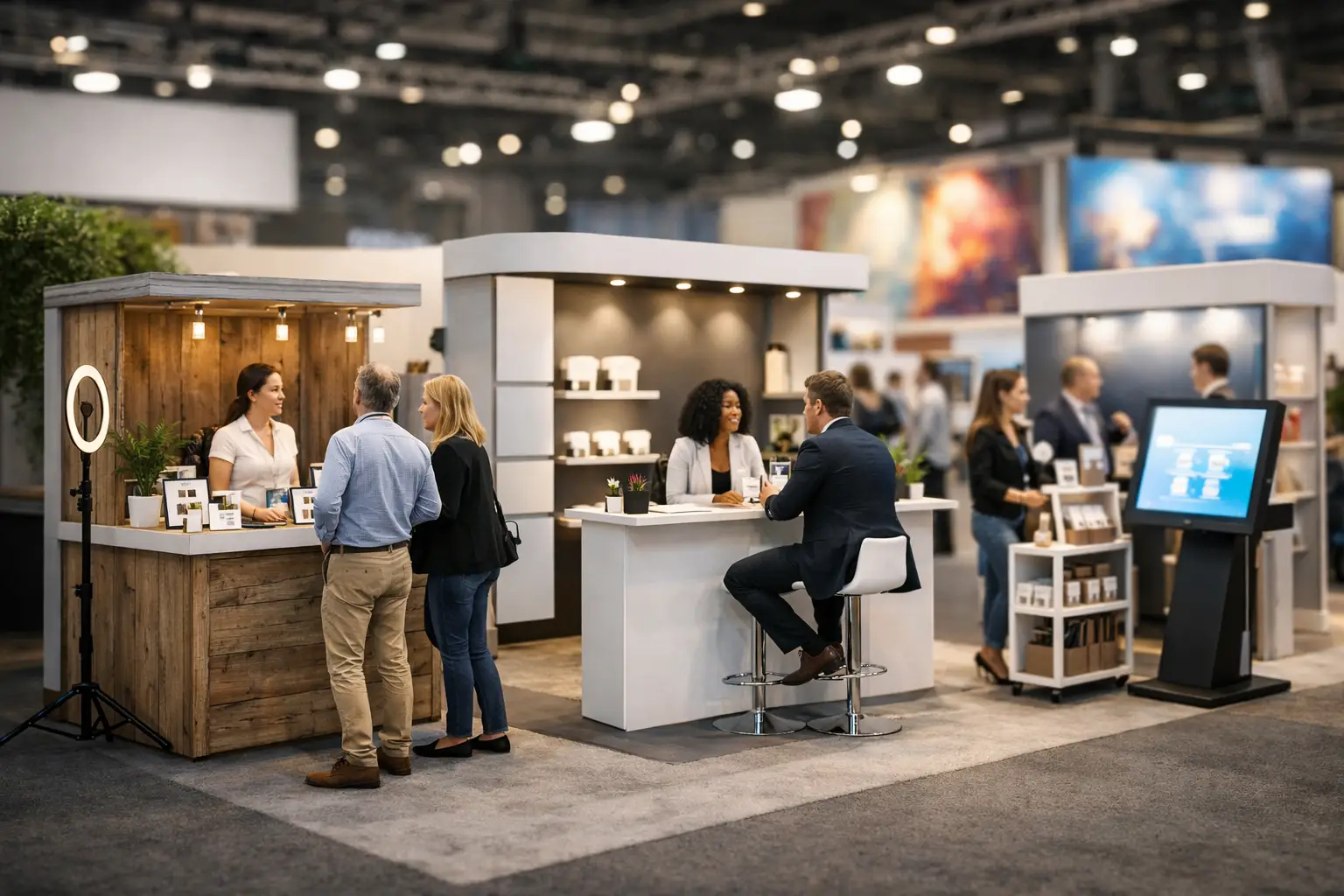
Use that space for a stronger interaction point instead. A sample, a touchscreen, a quick comparison chart, or a live consultation counter often generates more meaningful conversations than passive literature displays.
8. Create a compact meeting zone that still feels premium
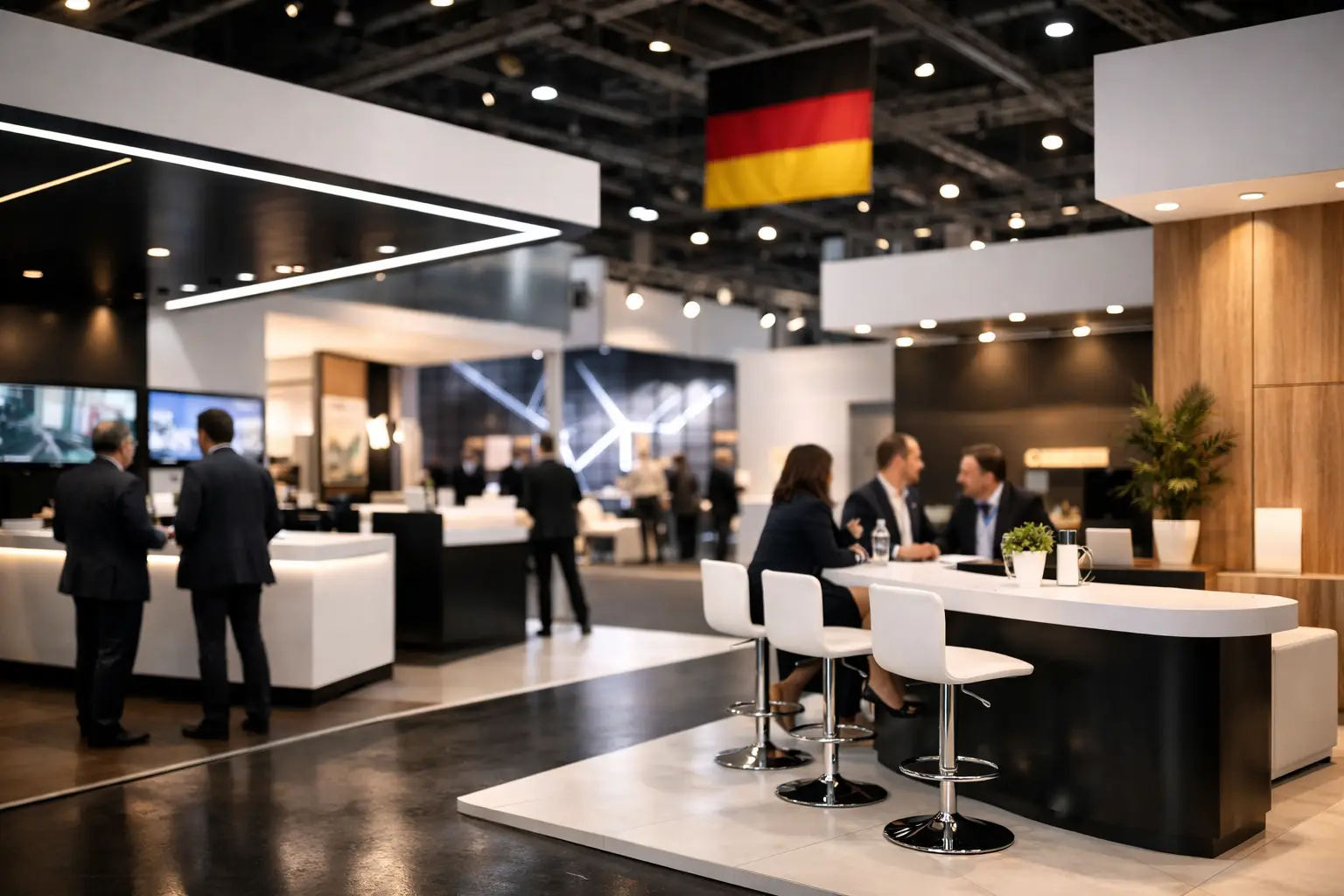
Many small businesses assume a small booth cannot support serious meetings. It can, if the space is planned properly. A compact round table, two to three chairs, and smart acoustic separation through layout or material placement can create a professional zone without swallowing the stand.
This is especially relevant at international trade shows where pre-scheduled meetings matter. Buyers, distributors, and procurement teams notice whether your space is built for business or just for display.
9. Use modular elements for repeat shows
If you exhibit more than once a year, modular planning is worth considering. A reusable system with adaptable graphics, counters, shelving, and lightboxes can keep costs under control across multiple events.
The trade-off is customization. A fully bespoke build may create a stronger first impression for flagship events, while modular formats are more efficient for roadshow-style participation or regional exhibitions. The right choice depends on how often you exhibit, where you exhibit, and how much variation each event requires.
10. Integrate storage early
Storage is one of the least glamorous parts of booth planning, but it affects everything. If bags, giveaways, extra stock, and personal items have nowhere to go, the stand quickly looks disorganized. In a small footprint, even minor clutter becomes visible.
Good storage can be hidden inside counters, wall units, or compact cabinets. The goal is simple: maintain a clean front-of-house experience while keeping your team functional throughout the day.
11. Design for lead capture, not just footfall
A busy booth is not always a successful booth. For many small businesses, the better metric is qualified conversations. That means the stall should make it easy for staff to capture interest, schedule follow-ups, and sort casual visitors from serious prospects.
Sometimes that means a formal lead capture station. Sometimes it means a demo flow that naturally leads into a sales conversation. The design should support the commercial objective. If the stand creates attention but not clarity, the result is traffic without momentum.
Budget-smart choices that still look premium
A limited budget does not require a low-impact presence. It requires discipline. Spend where visitors notice the difference: brand visibility, lighting, print quality, and one or two memorable features. Save where complexity adds little value, such as excessive furniture, too many finishes, or oversized storage areas.
Material choice matters here. Some finishes look impressive in renderings but are difficult to transport, repair, or reuse. Others offer a cleaner balance of appearance and practicality. Experienced stand partners usually help clients make these calls early, before production costs start climbing.
For brands exhibiting in major trade show markets such as Dubai, Las Vegas, or Mumbai, this matters even more. Venue rules, freight timings, and on-site build windows can quickly affect cost if the design is not operationally realistic.
Why execution matters as much as the idea
A smart concept only works when it is built well. Small stands leave very little room for error. Misaligned graphics, unstable lighting, poor finishing, or late installation are more obvious in a compact space because every detail is close to the visitor.
That is why businesses planning premium small-format booths often look beyond design alone. They want a partner who understands fabrication, logistics, show regulations, and on-site coordination. LemonTree Exhibitions works this way because exhibition success is never just about how a stand looks on screen. It is about how reliably it performs in a live venue, under real deadlines.
The strongest small exhibition stalls are not trying to imitate large ones. They are sharper, more selective, and more commercial in their decisions. If your next booth can be understood in seconds, support meaningful conversations, and stay true to your budget, you do not need more space. You need better intent.